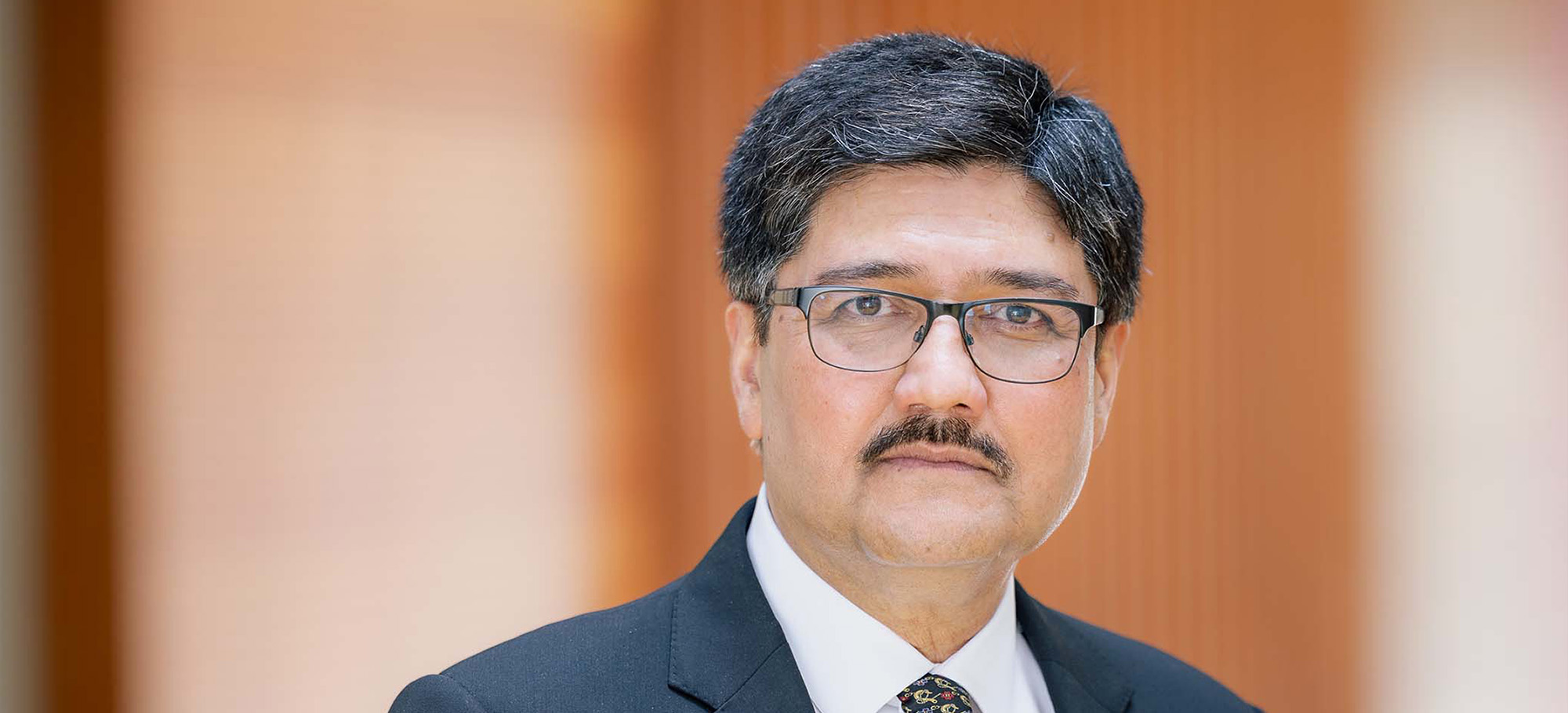
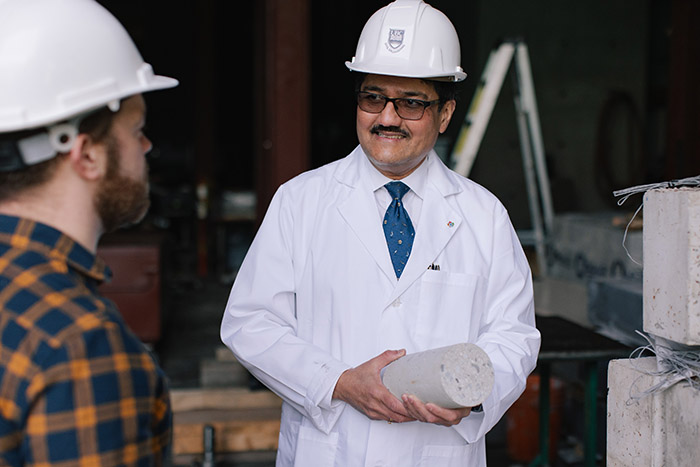
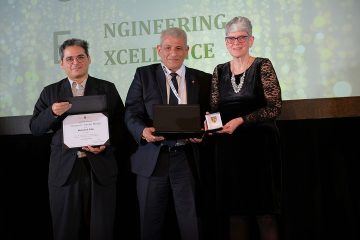
Dr. Nemy Banthia, a professor in our Department and a renowned global expert in structural materials, has been awarded UBC’s highest academic honor, the University Killam Professorship. This prestigious appointment acknowledges his exceptional contributions as a teacher, researcher, and international leader in his field.
Dr. Banthia is at the forefront and continues to push the boundaries of knowledge and understanding in concrete materials and structures, fracture mechanics, and sensor development for structural health monitoring. Within our Department, he has the highest h-index and overall citations, as well as being the most published faculty member. His work at UBC has led to revolutionary advancements in his field and cutting-edge techniques for repairing, strengthening, and rehabilitating bridges, buildings, and dams. He is one of the top 25 “Most Cited in the field of Construction & Building Materials” as per Platinum H-Index.
“I am extremely honored and humbled to be conferred UBC’s highest academic honor, the University Killam Professorship,” said Dr. Banthia, “Winning this award would not have been possible without the inspiration and support I have received from my family, my colleagues and my many graduate students who dedicated their lives towards achieving a collective vision of excellence.”
Not only is Dr. Banthia known for his groundbreaking research, he also actively shares and applies his knowledge on a global scale through collaborations and partnerships. He leads the Canada-India Research Centre of Excellence (IC-IMPACTS) as its Scientific Director and CEO. Under his leadership, IC-IMPACTS is now a gateway for multi-sector engagement between Canada and India with the goal of improving the quality of life of communities in both countries. To date, the consortium has placed more than 29 technologies in resource-limited communities, completed 74 joint Canada-India projects, published over 1,000 peer-reviewed papers, trained more than 900 graduate students, and launched eight start-ups. Many of the technologies developed by IC-IMPACTS in water, health, food security and housing have been placed in Indigenous communities in Canada.
Dr. Banthia is respected internationally for his commitment to excellence. He holds prominent positions on the external advisory boards for several leading universities around the world and his expertise and opinion on matters of promotion and tenure are sought after by universities in more than 31 countries. Furthermore, Dr. Banthia regularly serves on grant review committees for numerous international granting agencies.
Dr. Banthia’s work has been recognized with numerous prestigious awards. His awards include the Wason Medal from the American Concrete Institute, Solutions Through Research Award from the BC Innovation Council, Wolfson Merit Award from the Royal Society of the UK, Horst Leipholz Medal from the Canadian Society for Civil Engineering. Most recently, he received the Global Citizen Award from alumniUBC, a Distinguished Alumni Award from IIT-Delhi, and the Jacob Biely Prize, which is UBC’s highest research accolade. He is a fellow of the American Concrete Institute, Canadian Society for Civil Engineering, Indian Concrete Institute, Canadian Academy of Engineering (CAE), Indian National Academy of Engineering (INAE), and the Royal Society of Canada.
Professor Banthia joins Professor Dominic McIver Lopes (Philosophy, Faculty of Arts) andProfessor Natalie Strynadka (Biochemistry and Molecular Biology, Faculty of Medicine) in being appointed UBC’s three newest University Killam Professors this year. University Killam Professors will hold the designation for as long as they remain tenured members of faculty at the University.
Pamela Wolf, P.Eng. and Assistant Professor of Teaching in our Department, intimately understands how changing the systems around us can change how people live.
She’s worked with planners in Ghana and Engineers Without Borders to decolonize infrastructure decision-making systems, and seen the profound impact that skilled dialogue can have on the people who are most affected by those decisions.
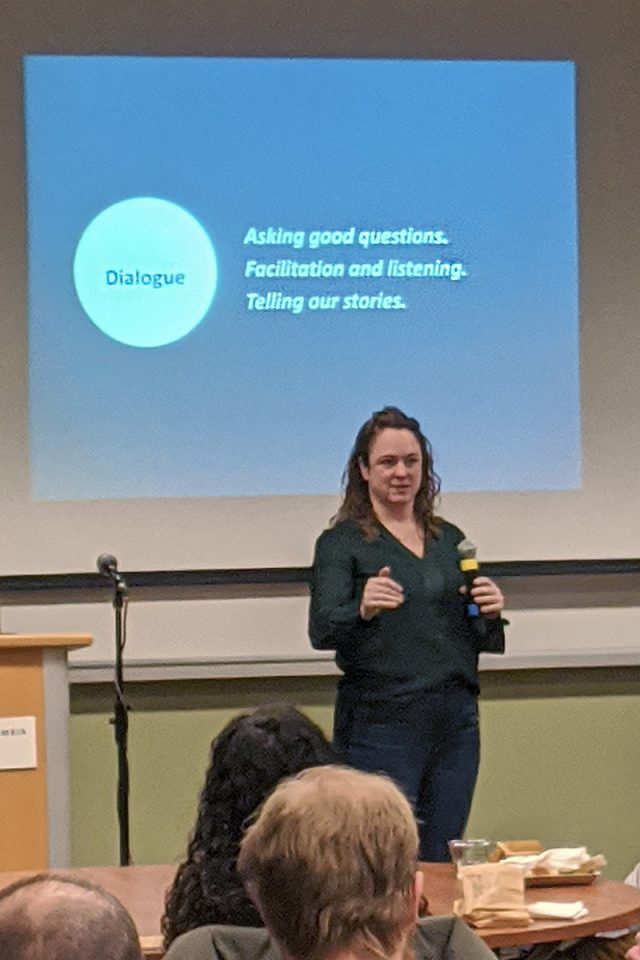
Ms. Wolf giving a presentation during the Reconciliation + Design dialogue series.
She witnesses the growth in her UBC students every year as she guides them towards practicing systems thinking, through her civil engineering courses and initiatives such as the Reconciliation + Design dialogue series, to make engineering a more inclusive, equitable profession.
“For me, creating inclusion in engineering is creating a set of actions to recognize many perspectives, and to bring these perspectives together in ways that will make a material difference to people,” said Wolf.
“And when we begin to make those changes — when we integrate different perspectives into our curriculum, or make cultural touchpoints like the Iron Ring ceremony inclusive — we’re taking substantial steps to make engineering a more welcoming and just profession.”
Wolf’s leadership and practice in fostering inclusion and belonging within engineering education at UBC is now being recognized with the Faculty of Applied Science’s inaugural Inclusion and Belonging Award.
As an uninvited settler living and teaching on Musqueam territory, Wolf is particularly conscious of her responsibility as an educator to understand and amplify Indigenous voices. She also wants to equip students with the practical communication skills needed to welcome diverse perspectives.
“For me, creating inclusion in engineering is creating a set of actions to recognize many perspectives, and to bring these perspectives together in ways that will make a material difference to people.”
Invited speakers are Indigenous change-makers who share their cultural perspectives on engineering design. Student facilitators lead smaller dialogue circles after each guest speech and attendees work on weaving Indigenous ways of knowing into their own perspectives.
Wolf points to this work of holding space for complex conversations as a practical communication tool that students can carry as they move into the wider world.
“As educators and as engineers, we are in systems change level positions. Every one of us is welcome in this space and in this work, to choose which voices we share, what gifts we give to our students.
“We are able to show our students what it is to joyously welcome different people into our community, then have them go out into the world to joyously welcome the different perspectives around them.”
The reconciliation + design series is co-designed and led by UBC Civil Engineering Assistant Professor of Teaching Pam Wolf and Civil Engineering graduate student Danilo Caron.
The series is supported by Applied Science Dean James Olson, and Associate Dean of Equity, Diversity and Inclusion and Professor Dr. Sheryl Staub-French.
These dialogues are a scaled Indigenization complement to decolonization curriculum. We invite anyone who reflects on reconciling their design processes to join the conversation. This is an interdisciplinary conversation on reconciliation and design.
Participants include UBC Applied Science students from the faculties of Engineering, School of Architecture and Landscape Architecture, and School of Community and Regional Planning, as well as external guests.
The speakers are Indigenous change-makers. We amplify their voices and listen to understand. Students and faculty practice authentic, experiential learning in dialogue circles, learning to weave together these Indigenous perspectives, ways of knowing, and ways of being, with our own as designers.
The breakout room facilitators are students. They will be practicing their skills leading dialogue circles.
The annual cycle of four topics spoken to by Indigenous leaders and elders is listed below:
January 8, 2023 marks the third anniversary of the downing of Ukraine International Airlines Flight PS752, which was shot down shortly after taking off from Tehran’s Imam Khomeini International Airport. Tragically, all 176 people onboard lost their lives, including 63 Canadians. Among those were four members of the UBC community: Niloofar Razzaghi, Zeynab Asadi Lari, Mohammadhossein Asadi Lari, and Dr. Mehran Abtahi, who was a postdoctoral research fellow in our Department.
Born and raised in Iran, Dr. Abtahi came to UBC in 2019 after completing his PhD in Process and Environmental Engineering at the Université de Toulouse, University of Twente, and Katholieke Universiteit Leuven. His doctoral research focused on the removal of micropollutants from wastewater using bioaugmented-moving bed biofilm reactors, nanofiltration membranes, and annealed polyelectrolyte multilayer-based membranes. Dr. Abtahi published numerous refereed papers and served on the editorial board of the Journal of Environmental Health and Sustainable Development.
In response to the downing of Flight PS752 and other air disasters, January 8 has been declared as the National Day of Remembrance for Victims of Air Disasters. On the third anniversary of this tragic event, we are thinking of the families, friends, and colleagues of not only Dr. Abtahi, but of all the individuals who were lost to the disaster.
Iranian Student Memorial Award
UBC has joined members of the Iranian-Canadian community in establishing the Iranian Student Memorial Award. This fund will provide awards annually to students in memory of those who lost their lives in this tragedy. Give now
Event: Justice Prevails: The 3rd Anniversary of the Downing of Flight PS752
January 8, 2023 | 2:00 pm North Vancouver – March from Ray Sergeant Park to the Shipyards. More info
Pilot project coming into effect alongside new federal mandate for COVID tests.
The Vancouver International Airport will soon be testing wastewater off flights arriving from China and Hong Kong, as part of the federal government’s efforts to track how many cases of COVID-19 may or may not be entering Canada from those regions.
The short-term pilot project, which is also being rolled out at the Toronto Pearson International Airport, is a sort of safeguard in addition to the negative COVID-19 tests required before boarding, beginning on Jan. 5. If people happen to test falsely negative, the virus may still be picked up in wastewater onboard the flight.
Both measures are part of the federal government’s response to a surge in COVID-19 cases in China. Experts have expressed mixed opinions on the pre-boarding testing requirement, with some criticizing it as a political move that is unlikely to actually reduce the spread of the virus, but many are in favour of more wastewater testing.
Ryan Ziels, an assistant professor of civil engineering with the University of British Columbia, was part of a team that implemented wastewater testing in Australia near the start of the pandemic. He says it was fairly common for them to detect COVID-19 onboard flights, despite negative test requirements.
“It’s a supplemental tool,” he says.
By testing wastewater from individual flights, Ziels says epidemiologists can narrow down the presence of COVID-19 to smaller groups of people and inform them if they should self-isolate. Of course, the testing was more effective at stopping the spread of the virus when people were required to quarantine after arriving in a new country. That isn’t the case anymore, and it will be up to people to choose to isolate on their own if they’re informed COVID-19 was present on their flight.
Unfortunately, the turnaround time for wastewater tests may prevent even this. A spokesperson for the Public Health Agency of Canada says results will likely take one to two weeks. Their focus appears to be more on detecting new variants entering Canada, rather than informing people of individual cases.
The timeline and specifics of the pilot project at YVR are still unknown. Trevor Boudreau, YVR’s director of government communications, says the government only reached out to them on Dec. 30, so they’re still figuring out exactly how things will work.
In the meantime, a separate, broader wastewater testing program is expected to start up at the airport in the next couple of weeks. Boudreau says this second program will test for COVID-19 in the airport’s overall wastewater, including from all flights and the terminal.
Chronic ship noise can lead to stress, hearing loss and feeding problems for marine mammals like whales, dolphins and porpoises. UBC researchers are diving in to help address the issue.
According to project lead Dr. Rajeev Jaiman, an associate professor in the department of mechanical engineering, propeller noise accounts for much of the acoustic barrage from ships.
“Propeller noise can hit 170 decibels, the equivalent of a jet engine or a rocket lift-off,” said Dr. Jaiman.
Popping and singing
The reason for the noise is bubbles. The ship’s movement and its propeller’s rotation create steam bubbles that then implode. This creates popping effects and a high-pitched “singing” that can irritate crew and passengers onboard and disrupt marine life within a 100-kilometre radius.
To reduce noise, the researchers are studying solutions like injecting a jet of fluid to help control propeller movement or introducing wavy and serrated edges to break up flow patterns that cause noise.
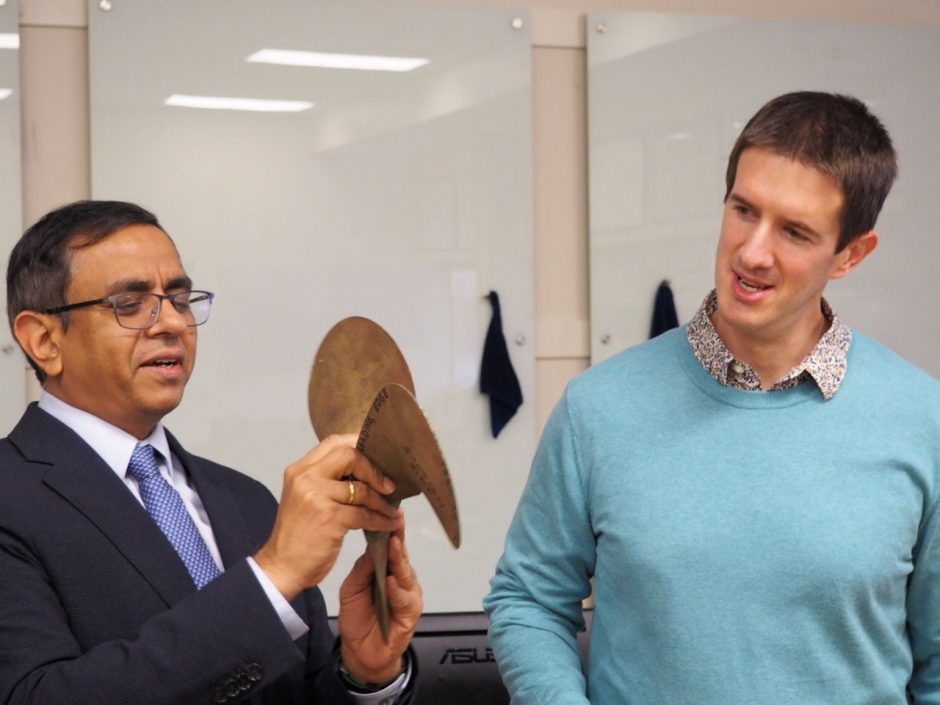
Researchers Jasmin Jelovica and Rajeev Jaiman are studying solutions like adding wavy and serrated edges to propellers to break up flow patterns that cause noise. Photo: Devan Power/UBC Faculty of Applied Science.
Dr. Jaiman and his colleagues are also developing an artificial intelligence (AI)-based framework to rapidly analyze the fluid interactions and dynamics behind the noise. They’re hoping to eventually provide marine engineers with a new suite of tools to design and manufacture quieter propellers.
Smart, lightweight structures
The team also aims to improve other ship parts and systems through better structural components and materials that have the ability to dampen noise.
Project co-lead Dr. Jasmin Jelovica, a naval architect and assistant professor of mechanical and civil engineering in the faculty of applied science, noted that innovative material layouts could reduce the weight of structural components by up to 50 per cent. “Advanced structures could be better noise barriers. They can be stronger and have other benefits as well.”
He added that a few ship manufacturers have started using sandwich panels made of metals and composites in the hulls of their ships. However, structural change can potentially affect safety and other aspects, so this type of change needs to happen slowly.
“The good news for us, as researchers, is that the marine industry is receptive to these innovations. They recognize the need to change and to become more sustainable and environmentally friendly,” said Dr. Jelovica.
The researchers are working closely with industry partners such as Seaspan Shipyards, Robert Allan Limited and Vard Marine in this five-year project, with funding support from Natural Sciences and Engineering Research Council of Canada (NSERC).
AI to help build greener ships
AI and machine learning are a big part of the team’s work, enabling them to perform analysis and simulations in a fraction of the normal time.
“Modelling a ship using traditional computational methods takes time. Modelling even a tiny proposed structural change can take weeks. With AI, that work can be done in a matter of seconds,” said Dr. Jelovica.
The researchers recently received additional funding from Transport Canada’s Quiet Vessel Initiative to build a machine learning-based noise-prediction toolkit that will allow ships to adjust their noise based on the location of nearby marine mammals, and new AI software tools that can predict underwater vessel noise early in the design stage.
“Efficient AI-based predictions together with novel flow control devices and structural modifications can help us to tackle ship noise pollution while reducing carbon emissions,” said Dr. Jaiman.
When Danilo Caron returned to school for an engineering degree, he never imagined how much his new career and research would support his personal journey to connect with his Anishinaabe culture.
Years spent working as a masonry contractor in his father’s family business instilled in Caron a unique perspective and appreciation for engineering design, while his efforts to form closer relationships with his mother’s community of Sagamok Anishnawbek and learn Anishinaabemowin as an adult nurtured a growing desire to build understanding of Indigenous world views.
“Since returning to school, I’ve come to realize and appreciate the need for intercultural collaboration between architects, engineers and construction industry practitioners, and Indigenous Knowledge Keepers,” said Caron, now a UBC PhD candidate in civil engineering and a practicing engineer-in-training.
“The connections between my engineering career, academic research and cultural journey motivate me to help establish a bridge between the industry I am passionate about and Indigenous ways of knowing that have been suppressed under colonialism. There are many challenges facing Indigenous communities and I want to be a partner in addressing them through decolonizing engineering design and project delivery.”
The IBET Momentum Fellowship is part of the IBET PhD Project, a Canada-wide initiative that aims to address the urgent need for Indigenous and Black students to pursue graduate studies in STEM and build a more diverse, equitable academic environment. The Fellowship provides $25,000 per year for four years, and includes mentorship and community-wide support.
Caron’s receipt of this award also recognizes his contributions to creating a more welcoming environment for Indigenous students and advancing reconciliation across UBC, from helping to restart UBC Vancouver’s chapter of the American Indian Science and Engineering Society for Indigenous STEM students to connect with each other and professionals, to organizing the Faculty of Applied Science’s first intergenerational march for Orange Shirt Day in 2019, an annual event which has since expanded across UBC since.
Exploring intersections between Eurocentric engineering design and Indigenous world views
Caron credits an Indigenous student research mentorship program for introducing him to the world of research as an undergraduate.
“Before that, research was foreign, mysterious and reserved for career academics,” he said. “The glimpse I received into research methodologies, experimentation and collaboration led me to take a directed studies course, where I experienced a new freedom to pose questions and seek understanding.”
His directed studies formed the groundwork for his master’s thesis, where he created a framework for project delivery with Indigenous communities and methods to incorporate Indigenous ways of knowing that can be adapted for different organizations.
In this work, Caron looked at two separate projects led by UBC and the City of Vancouver, where both project owners wanted to incorporate Coast Salish ways of knowing at an early stage.
“Urbanization—the act of building upon the land—reflects the values and needs of the people that occupy that land,” he said. “By building relationships with Indigenous peoples early on, you build in space for different values and ways of knowing, which will inevitably change how you look at things.”
He cites UBC’s Gateway Building as one example of this intercultural collaboration in action. In planning the building—which will serve as an interdisciplinary home for health-related disciplines—UBC engaged with Musqueam and learned that the original building design had not considered a key Musqueam principle of wellness: the connection between the health of the land and human health.
As a result, UBC shifted the building site to allow for ecological restoration in the landscape design.
Caron believes this was a key step in UBC’s ongoing efforts towards reconciliation. “If UBC as a project owner had moved forward without Musqueam’s involvement, Gateway would simply have been a shell for teaching and learning about health. Now it is truly a building representing health for the UBC community and for the Musqueam nation on whose land we are situated.”
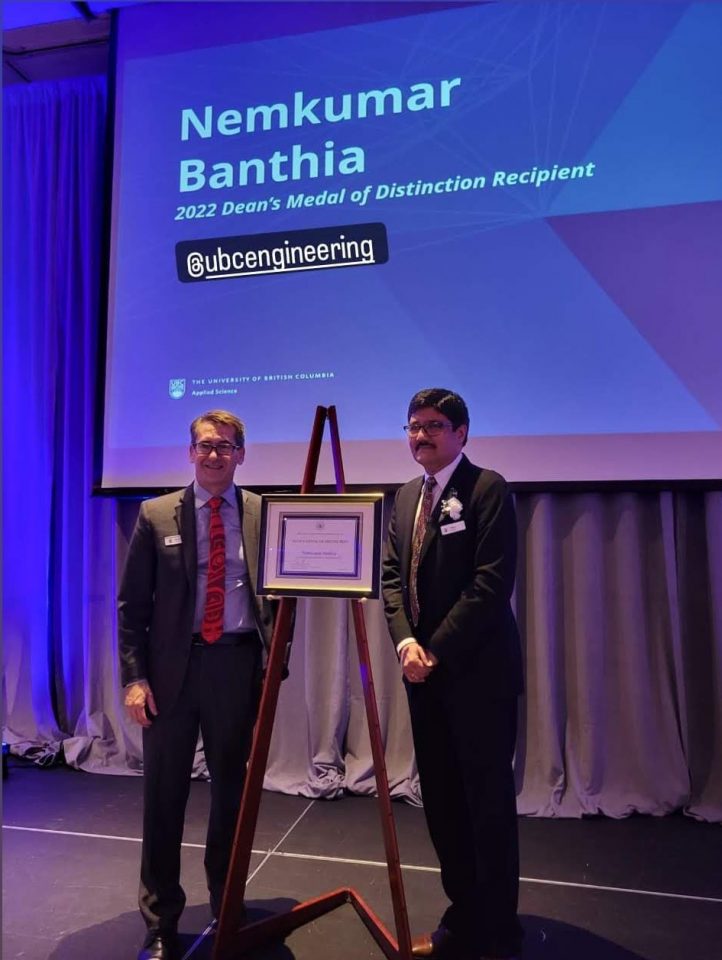
Dr. Nemy Banthia has been announced as a recipient of the Faculty of Applied Science’s 2022 Dean’s Medal of Distinction. Our Faculty’s highest honour, this award recognizes individuals who have made significant contributions to the advancement of the Faculty’s vision, mission and mandate.
One of the leading experts in the world in his field, Dr. Banthia‘s research focuses on the behaviour of concrete structures under various environmental conditions. In particular, he studies the effects of temperature, moisture content, and chemical composition of concrete on the strength and durability of concrete structures.
Dr. Banthia’s dedication to using advanced technologies to improve the lives of people around the world has had an incredible global impact and brought great recognition to the Faculty. He has been involved in many projects related to bridge rehabilitation, earthquake resistance, and seismic retrofitting of existing infrastructure. He has also worked extensively on developing new technologies for detecting cracks and defects in concrete structures.
Dr. Banthia’s research has been extremely influential, having been cited nearly 18,000 times by other researchers. His 450 refereed papers, 9 patents, 20 monographs, and 75 doctoral and post-doctoral students have had a major impact on the field.
The sheer volume of Banthia’s research, the number of disciplines he collaborates across, and his outstanding publication record are all testament to his leadership and creative genius.
A celebrated member of the Department, Nemy’s awards include the Wason Medal of American Concrete Institute, Solutions Through Research Award of the BC Innovation Council, Wolfson Merit Award of the Royal Society of the UK, Killam Research Prize, Horst Leipholz Medal of the Canadian Society for Civil Engineering and the Mufti Medal of Excellence of the International Society for Health Monitoring of Infrastructure (ISHMII).
Recently, Dr. Banthia received the Global Citizen Award from alumniUBC, a Distinguished Alumni Award from IIT-Delhi, and the Jacob Biely Prize from UBC. Among others, he is Fellow of the Royal Society of Canada and the National Academy of Engineering.
Nemy is also the founding Scientific Director of $100 million Canada-India Research Center (IC-IMPACTS).
A UBC expert on PFAS — also known as forever chemicals — has applied to do research on how much of the toxic substances lurk in B.C.’s drinking water.
Exposure to the chemicals, which are widely used in rain gear and non-stick cookware, have been shown to have a wide range of health impacts, including immune suppression, cancer, and cardiovascular disease, said Rachel Scholes, an assistant professor in UBC’s department of civil engineering.
She spoke to Postmedia Wednesday following a shocking European study that shows rainwater is unsafe to drink globally because of the persistent levels of PFAS in the atmosphere.
The study, by researchers at Stockholm University and ETH Zurich and published Tuesday in the journal Environmental Science and Technology, says rainwater is unsafe to drink in every area of the world — even in Antarctica and on the Tibetan plateau — because of high amounts of PFAS, formally known as per-and polyfluoroalkyl substances.
PFAS are ubiquitous in consumer products. Canada no longer allows PFAS in personal care products but they are still used in manufacturing.
Scholes has applied for funding and hopes to start her research next year to test B.C.’s drinking water, which she assumes will have some PFAS. Whether there are unsafe levels though is yet to be determined.
She said the Stockholm study highlights just how prevalent these chemicals are in the environment.
“I think one of the big take-aways of this most recent study is just that these compounds are so widely distributed in the environment that we almost certainly would find them (in B.C.’s rainwater.)”
Scholes cannot make recommendations for B.C. residents who collect and drink rainwater because “the data just isn’t there.”
Dan Kovacek is a PhD candidate in hydrotechnical engineering supervised by Dr. Steven Weijs in the Department of Civil Engineering. His research interests are focused on the nature of uncertainty in water resources management and hydrology. Dan has over 15 years experience in engineering consulting in British Columbia, primarily supporting various aspects of hydropower planning, design, construction, and operation. Drawing from this experience, Dan taught a course in the fundamentals of run-of-river hydropower at BCIT from 2016-2019.
Research Interests
Water resources management, mountain hydrology, catchment hydrology, flood forecasting, uncertainty, information theory
Awards
2020 – 2022: President’s Academic Excellence Initiative Awar 2020 – Earl R Peterson Memorial Scholarchip in Civil Engineering 2018 – Brian R. Hughes Graduate Award in Hydrotechnical Engineering
Dr. Nemy Banthia, a professor in the UBC Department of Civil Engineering, has been awarded $1.5 million from the Natural Sciences and Engineering Research Council of Canada (NSERC) Alliance program on a project to repair and rehabilitate Greater Vancouver’s sewerage systems.
Maintaining and repairing aged sewerage is an ongoing challenge for many municipalities and regional utilities. Around Canada, it poses a $9 billion problem. This is especially complicated for sewerage systems under crowded urban areas, which require careful planning for assessment, repair, and replacement.
A collaboration with Metro Vancouver and industry partners, Dr. Banthia’s project will utilize robotic placement technologies to improve efficiency and reduce both cost and CO2 emissions for corrosion protection and rehabilitation of sewerage systems.
The project aims to improve upon a recently developed and patented Multiphase Composite Coating (MCC) materials that have 65%-85% less embedded carbon than that of currently used traditional Portland cement mortars.
The project will approach carbon neutrality in MCC materials by using carbon sequestration, recycled sand, natural biocides, and fibers derived from scrap automobile tires.
The carbon-neutral MCC materials developed in this project will be applied to six field demonstration projects including existing pipes, manholes, and chambers.
Full-scale trials with Metro Vancouver will improved the MCC technology and reduce both material and placement costs.
Although most metal-rich suspended sediment from the disaster has been flushed, some remains in circulation
Nearly eight years after the largest tailings spill into a lake ever recorded, impacts of the Mount Polley Mine disaster in central B.C. are still being observed.
While most of the contaminated solids released during the spill on August 4, 2014 settled to the bottom of Quesnel Lake within days, tens of thousands of tonnes of especially small particles remained in suspension months later and are still detectable today.
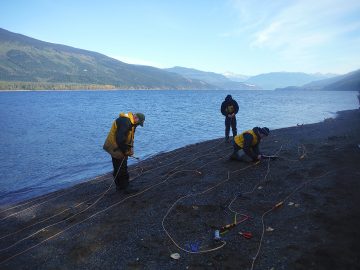
The researchers assembling a mooring rope with sensors, which will be deployed in the lake to measure temperature and turbidity.
“When we started taking measurements in August 2014, the deep water offshore of where the tailings flood entered the lake was hundreds of times more turbid than it was before the spill,” says Brody Granger, a research associate in the department of civil engineering at UBC and lead author of a study published recently in the journal Water Resources Research. “As of late fall 2021, those impacted regions were still one and a half times more turbid than elsewhere in the lake.”
The study found that in the months following the spill, some 30,000 tonnes of suspended tailings solids entered the main basin of Quesnel Lake, upstream of the west basin where the spill occurred. Based on a mathematical model and field observations of turbidity, the authors estimate that it will take about a decade starting from the time of the spill for the lake to substantially flush out the finest fraction of these tailings solids.
The authors say the massive spill is bound to have long-lasting impacts on water quality in the lake. Dr. Ellen Petticrew, a geography professor at the University of Northern British Columbia, noted that while fine sediment loads have been reducing in the west basin over the past eight years, the impacts are still being observed in the river outflows, indicating continued mobility of the contaminated mine tailings and sediment. “Each winter since the spill, and again in 2022, concentrations of copper associated with the fine sediment coming from the lake exceeded background levels by an order of magnitude.”
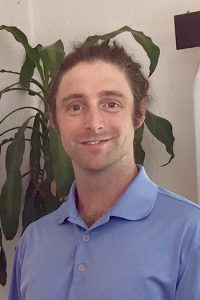
Lead author Brody Granger
Dr. Petticrew leads the multiyear research project, which includes other scientists from UBC, University of Alberta, University of Lethbridge, and Fisheries and Oceans Canada. The group has continued its research on the environmental impacts of the August 2014 spill, and more recently has shifted some of its focus to impacts of ongoing mine wastewater discharge into Quesnel Lake.
Dr. Petticrew noted that a recent publication from this project by partners in the study found significant copper accumulation in mayfly larvae in Quesnel Lake’s west basin. These organisms are an important food source to local fish species.
The authors said Mount Polley Mining Corporation ceased its investigation into the fate of suspended tailings solids after just two years, leaving many in the community frustrated and uncertain about the spill’s impact on Quesnel Lake.
This research was supported by funding from Environment and Climate Change Canada’s Environmental Damages Fund, UBC’s department of civil engineering flood fund, as well as in-kind support of instrumentation from Fisheries and Oceans Canada and Mount Polley Mining Corporation.
After years of research, a wood scientist, a mechanical engineer, and a chemical engineer have invented a new way to protect cities from climate change: turning buildings into giant trees. Or at least, their invention can make some buildings do some of the things that trees can. The team behind the “Developing Artificial Trees for Extreme Weather-Resistant Cities” project is developing a tri-layer film that can absorb water from the ground and release it into the air, the same way the roots, trunks, and leaves of trees do. When stuck to urban structures, this film could help soak up water during floods and keep cities cool in scorching weather.
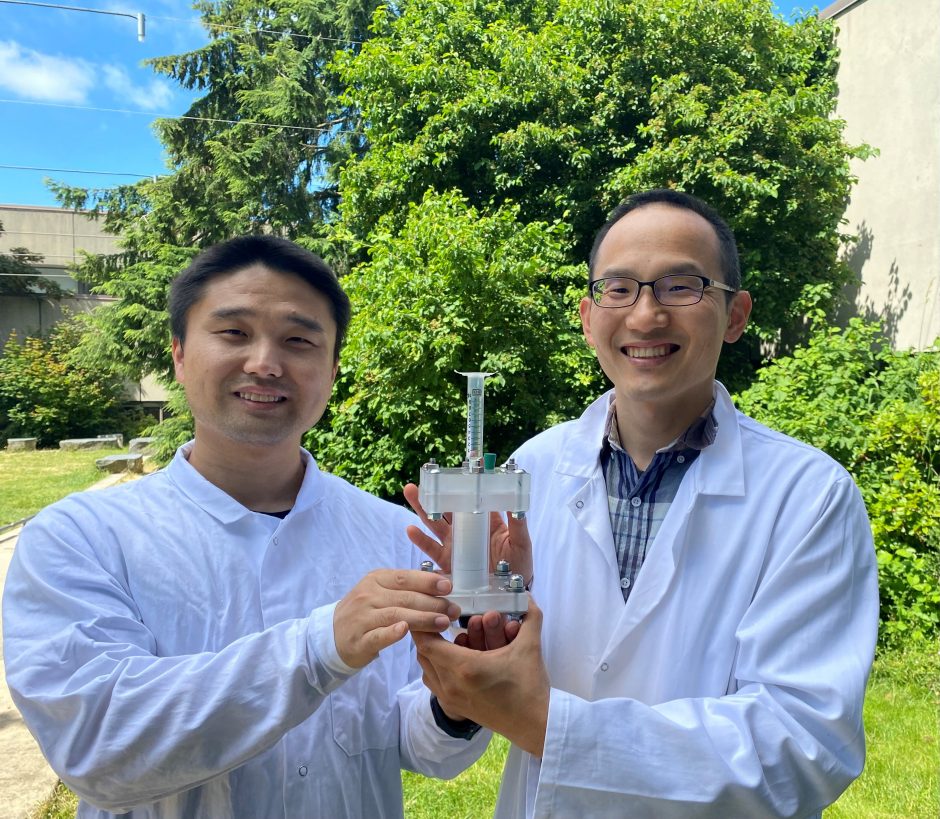
Dr. Jongho Lee and Dr. Linfeng Piao
“We were prompted by increasingly frequent extreme weather,” says co-lead Dr. Jongho Lee, an assistant professor in the Department of Civil Engineering. “We thought, ‘If only there were more trees, we could minimize the damage.’”
Lee is developing the film along with assistant professor Feng Jiang, a Canada Research Chair in Sustainable Functional Biomaterials based in the Faculty of Forestry, and associate professor Simcha Srebnik from the Department of Chemical and Biological Engineering, with backing from the federal New Frontiers in Research Fund. The inspiration for the project came from Lee’s previous experiments fabricating artificial mangrove trees as a way to turn salt water into fresh water. But desalination is just one of the myriad things trees can do, Lee observes. They also absorb excess rainwater and act as natural AC units.
Thus, motivated by a year of both heatwaves and floods, Lee and like-minded scientists from three different university departments have set out to turn entire cities into forests. Their film can be applied to apartment buildings, warehouses, support columns, and pretty much any other static structure, transforming them into giant artificial trees. The film is actually a set of three separate materials, each mimicking a different natural process: The first layer, a tight membrane, acts as a root system, sucking up water from streets and gutters, while rejecting contaminants. The middle layer acts like a trunk, transporting water up the side and roof of a building. Finally, a top canopy surface allows the moisture to be evaporated through microscopic pores, just like real leaves.
“Nature is a great teacher,” says Feng Jiang, who has studied the molecular structure of wood, and focuses on the structural elements of the tri-layer film. His research program aims to mimic nature and develop high-performance materials out of its abundant resources, with examples ranging from super-strong cellulose fibres inspired by spider silk and lightweight porous materials inspired by wasp nests. Revolutionary synthetic materials, such as strong and tough composites, he says, are the result of generations of studying what nature has done for eons. “If nature can make those beautiful, strong, and lightweight materials, why can’t humans make them?”
Illustration by Clare Mallison
In making the tri-layer film, Feng’s chief challenge is materials selection. While the film can be easily fabricated out of petroleum-based polymers, this presents problems, such as plastic pollution. “We don’t want to solve one problem by creating another one,” he says. To avoid the issue, the team is once again looking to nature by experimenting with nature-based materials, such as cellulose, which is the structural component of actual wood and could be a way to make the film layers both durable and biodegradable.
The team believes the film could eventually be mass-produced, but there are still a few kinks to work out. For one, the film is not particularly attractive, commented Lee; people might be reluctant to stick it to their apartments and city landmarks – though it would likely be fine for existing eyesores, such as factories and water towers.
An alternative to attaching the film, says Lee, is to incorporate its functional structure into the building blocks used for construction.
The specific form their invention takes is secondary. The most important thing is to stop battling nature and start learning from it – before it’s too late. Last year’s Pacific Northwest heatwave killed at least 1,400 people. A few months later, in the same region, torrential rains and severe flooding caused more deaths and billions of dollars in damage. And those events may only be the start. If our cities are going to weather what is coming, we are going to have to adapt wherever we can, even if it means converting our cities into artificial forests.
“This is a crazy idea, I know,” Lee says. “Nature has lots of crazy and fascinating features. It’s natural that we can get great ideas from nature.”
UBC Civil Engineering faculty and students received best paper awards at the 2022 Canadian Society for Civil Engineering (CSCE) Annual Conference recently held in Whistler, BC.
Professor Tarek Sayed was awarded the Thomas C. Keefer Medal for his paper, “Enhancing unsupervised video-based vehicle tracking and modeling for traffic data collection,” co-authored with Mohamed H. Zaki and Moataz Billeh.
The paper illustrates a new computer vision approach to traffic video surveillance and proposes two major improvements. It also evaluates the effectiveness of these approaches through a case study using real-life traffic video data from three Canadian cities.
The Keefer Medal, established in 1941, is presented annually for the best civil engineering paper in hydrotechnical, transportation, or environmental engineering.
First-year PhD students Weijia Cai and Lei Huang received the Best Student Paper Award, General Conference. Written under the supervision of Assistant Professor Zhengbo Zou, their paper is titled “Virtual Reality-Based Expert Demonstrations for Training Construction Robots via Imitation Learning.”
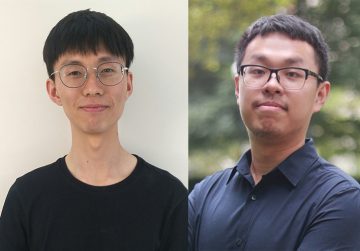
Weijia Cai (left), Lei Huang (right)
The paper was recognized for proposing a novel approach to training robot arms to conduct construction activities in simulation. It describes in detail how activities such as window pickup and installation can be successfully automated via an imitation learning paradigm that learns from demonstrations collected in virtual reality.
“The integration of robotics into the construction industry is integral to solving current and persistent global challenges such as labour shortage, low productivity, and unsafe working conditions,” said co-authors Cai and Huang.
Earlier in the month, Cai and Huang attended the IEEE International Conference on Robotics and Automation in Philadelphia, PA, which is the flagship conference on robotics, internationally. At the conference, each student had a paper accepted into the Workshop on Future of Construction: Build Faster, Better, Safe – Together with Robotics.
Assistant Professor Rachel Scholes was recently featured as an Emerging Investigator in the environmental chemical sciences by the Royal Society of Chemistry.
The Emerging Investigator series highlight the best work conducted by early career scientists who have been identified as having the potential to influence future directions in the field. As part of the accolade, she was interviewed and featured on the official Royal Society of Chemistry blog.
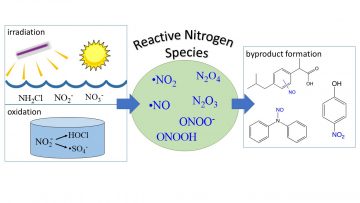
Your recent Emerging Investigator Series paper focuses on Contributions of Reactive Nitrogen Species to Transformations of Organic Compounds in Water: A Critical Review. How has your research evolved from your first article to this most recent article?
I was very fortunate to have opportunities to explore research as an undergraduate student, and I discovered a deep interest in environmental chemistry, particularly the fate of trace organic contaminants. Since then, I have approached trace contaminants from multiple perspectives. My first, first-author paper is from my Fulbright research in an environmental chemistry laboratory, which focused on the bioaccumulation of halogenated pesticides in trout from a large river system on New Zealand’s South Island. My studies in New Zealand allowed me to develop strong analytical chemistry skills and an understanding of contaminant fate and transport. I brought that background in environmental chemistry to my PhD research in environmental engineering. In my subsequent research, I queried the fate of pharmaceuticals and urban-use pesticides in engineered wetlands, and worked with green chemistry experts to assess lower-hazard alternatives to harmful chemicals. Each of these experiences has allowed me to refine my approach to addressing trace contaminants and their impacts. When I was studying open-water wetlands during my PhD, I became very interested in photochemical transformations, and reactive nitrogen species in particular. This most recent article builds on my PhD research by focusing on reactive nitrogen species and the resulting formation of toxic byproducts in water treatment processes.
What aspect of your work are you most excited about at the moment?
I recently started my position as a faculty member at UBC and am very excited to develop my own research group. I really enjoy sharing the excitement of doing research with my students. I am most looking forward to working with them to further advance our understanding of trace contaminant transformations and mitigate the risks posed by toxic chemicals.
In your opinion, what are the most important questions to be asked/answered in this field of research?
Transformation products are increasingly being considered in environmental engineering research, especially as high-resolution mass spectrometry becomes more widely available in research laboratories. With hundreds of thousands of parent compounds, it is unrealistic to experimentally assess all of the possible transformation products. Even if we know which products will form, we often do not have sufficient information about their toxicity and fate. As advanced analytical tools enable us to better detect the plethora of chemicals present in the environment, we need methods to prioritize which ones are of highest concern. This is one reason why I am interested in reactive nitrogen species – because they result in the formation of nitrated and nitrosated byproducts, which are often more toxic and less easily degraded than the parent compounds.
What do you find most challenging about your research?
Being somewhere between an environmental chemist and engineer presents the challenge that my research often spans a wide range from fundamental to applied. My research requires that we expand our mechanistic understanding of contaminant transformations while studying realistically complex environmental systems. For example, when we look at constructed wetlands, we have multiple processes directly affecting contaminant transformation (e.g., sorption, biotransformation, photolysis) as well as design parameters that influence these processes indirectly, such as hydraulic retention time, flow paths, and redox conditions. As someone who loves to understand the underlying principles of a system and the practical implications, I am constantly trying to bridge the gap between fundamentals and applications.
In which upcoming conferences or events may our readers meet you?
I will be at the American Chemical Society meeting this August in Chicago, and I hope to be attending more in-person conferences soon.
How do you spend your spare time?
I spend as much of it outdoors as possible. I love trail running, backpacking, and exploring the Pacific Northwest. I am also a musician. On stormy days you’ll likely find me playing my French horn or reading a novel.
Which profession would you choose if you were not a scientist?
When choosing an undergraduate major, I pretty seriously considered becoming a music teacher. In fact, I started out in a dual degree program majoring in music education and chemical engineering. If I was not a scientist, I would probably be directing music groups and teaching kids to play musical instruments.
Can you share one piece of career-related advice or wisdom with other early career scientists?
Spend the time to forge strong relationships and learn from your peers. Learning about research directions adjacent to your own can spur new ideas and building strong relationships with other students and postdocs can help you create a network of support in your future career. I keep in touch with friends from graduate school both inside and out of academia. Being in touch with other new faculty members has provided me with an incredibly helpful support system.
Love them or hate them, new mobility devices like e-bikes are here to stay.
In one of the first large-scale studies to measure the real-world usage of these devices, UBC transportation researchers found that most other road users are comfortable sharing cycling lanes and off-street paths with these new modes of transport—despite some misperceptions of how fast these devices are actually going.
Take electric bikes, currently enjoying a boom in Metro Vancouver and other cities.
“Many people like electric bikes but others worry that they travel at high speeds, although in reality they don’t – at least not according to the observations in our study,” says UBC researcher Amir Hassanpour, a PhD student in transportation engineering in the faculty of applied science.
“Many of the people we surveyed thought electric bikes go 4 km/hr faster than they actually do, but in fact most of the e-bikes we saw were actually travelling well below the speed limit of 32 km/hr,” says Hassanpour.
Hassanpour and his colleagues set up observation stations at 12 locations across Metro Vancouver, installing GoPro cameras and laying pneumatic tubes on the road to count vehicles and determine vehicle types and speeds. They also conducted a survey to determine how comfortable path users (including pedestrians and people on conventional and electric-powered devices) felt while using the same roads and trails.
One major misperception was that the surveyed path users believed that electric-assist devices were three times more prevalent than they actually were. Hassanpour chalks up these perceptions to the fact that e-bikes are relatively new, so we remember them more vividly and start thinking they’re more prevalent than they actually are. “It’s what’s called a frequency illusion—once you encounter a new emerging vehicle, all of a sudden you see it everywhere.”
These mental biases could also affect perceived speed, he theorizes. In fact, average speeds for electric-assist devices were around 20-22 km/hr, only slightly faster than conventional bicycles.
The UBC camera stations observed more than 25,000 vehicles representing 25 different mobility devices ranging from pedal bikes, push scooters and roller skates to moped-style scooters and even golf carts.
Their findings—published today for the first time—paint an image of relative comfort and safety for users of these shared paths and bike lanes.
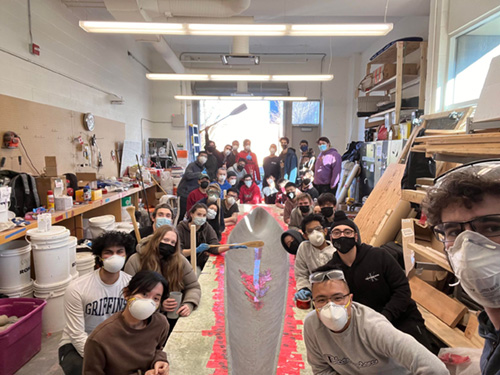
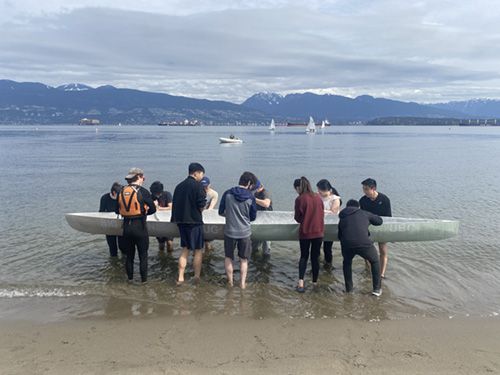
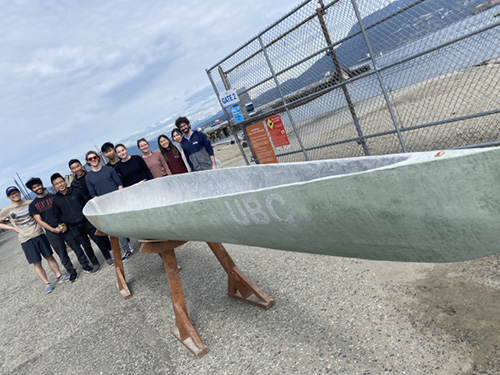
After overcoming challenges presented by the COVID-19 global pandemic, UBC Concrete Canoe made a triumphant comeback at this year’s American Society of Civil Engineers (ASCE) Concrete Canoe Pacific Northwest Regional Competition, where they won the top prize for the first time.
Each year, the competition challenges participating student teams to design, construct, and race a canoe made entirely from concrete. The goal is to build the strongest and most hydrodynamically efficient and lightweight concrete canoe possible.
UBC Concrete Canoe’s winning design this year featured low-density concrete with a dry specific gravity of 0.90, which allowed for floatation without foam bulkheads; a modified hull design optimized for the paddler’s speed in a straight-line, and a 5-colour aesthetic design—the most advanced in the team’s history.
Advised by Assistant Professor Dr. Omar Swei, the team formed in 2013 and has steadily improved year after year. After placing second in 2019 and 2021 (2020’s competition was canceled), the team finally bested rival University of Washington this year. Winning regionals means the team will go on to represent the Pacific Northwest at the ASCE National Concrete Canoe Competition in June.
“I joined UBC Concrete Canoe in 2018, having been on the mix team for two years before being co-captain for two years during COVID,” said Ryan Carrusca (Civil, ’22). “I am very proud of this team and what we have accomplished this year, through the hardship of COVID-19 and returning to campus after our hiatus.”
The team’s victorious finish this year was the result of perseverance and hard work, as hardships arising from the COVID-19 global pandemic challenged the team to re-examine the situation and apply new solutions.
When the world shut down in March 2020, all in-person activities were and remained canceled for almost two years.
“As a result, retaining junior members was a challenge, and our lead members with the most experience had graduated,” said Carrusca.
This past September, when in-person activities finally resumed, the team found themselves comprised of mostly members who had never participated in in-person activities before.
Carrusca, for his part, took this opportunity to encourage the team to cultivate resilience and demonstrate adaptability.
“We allocated more time in our schedules for knowledge transfer and re-learning construction activities, as we had to ensure members had the skills required to design and construct our canoe this year and in the future,” he said.
That the team finished so strong in spite of the challenges is a testament to strong leadership, teamwork, and the generous support from industry sponsors, which include Xypex, Ellis Don, Hatch, Pomerleau, and many more.
“We rely on the support of our sponsors to make our team a success,” said Carrusca. “Their support in material, construction, and transporting costs have ensured that our team members can further their personal and professional development at competitions.”
UBC Concrete Canoe is comprised of over 35 students from all years, representing primarily Civil Engineering, but also other disciplines and faculties as well. Students who join may expect to gain design experience in concrete mix, hull shape development, visual and graphic design, and report writing, as well as teamwork, project management, and finance.
To learn more about UBC Concrete Canoe and how you can participate, visit yesitfloats.ca.
Dr. Tony Yang, a professor in the Department of Civil Engineering, and his team of researchers recently received a two-year, $1 million grant to lead the development and implementation of advanced structural and robotic technologies aimed at creating smarter and more resilient infrastructure.
The team received the Natural Sciences and Engineering Research Council of Canada (NSERC) Alliance Missions Grant, which is aimed at “addressing critical science and technology challenges that can play a pivotal role in Canada’s economy.”
“This is a major funding opportunity for the Department,” said Yang. “My team and I are excited to work on this project to make future infrastructure smarter, more resilient and more sustainable.”
The technology that the team aim to develop will tackle multiple challenges faced by the global construction industry.
Currently, increase in demand for infrastructure to be built quickly, shortage of skilled workers, tightening climate regulations and rising material costs have come together to create a perfect storm.
Dr. Yang and his team will develop novel structural and robotic technologies to assemble high-performance buildings. Not only will these buildings reach new heights, they will also be constructed more efficiently, thereby reducing carbon emissions and addressing labour shortage concerns.
Led by Dr. Yang, the research team includes Dr. Zhengbo Zou (Assistant Professor, UBC Department of Civil Engineering), Dr. Cristiano Loss (Assistant Professor, UBC Department of Wood Science), and Dr. Dorian Tung (Manager of Timber Building Systems, FPInnovations).
Dr. Yang joined the Department of Civil Engineering in 2010 from the University of California, Berkeley. He is regarded as one of the leading earthquake engineering experts in the world, having led the development of the fundamental underpinnings for performance-based earthquake engineering (PBEE) and its implementation in design codes worldwide.
Most recently, Dr. Yang was elected onto the Editorial Board for the Computer-Aided Civil and Infrastructure Engineering. With an impact score 11.775, the journal is ranked 1st in categories of Civil Engineering, Construction & Building Technology, and Transportation Science & Technology.
For more information about Dr. Yang and his work, please visit the website of UBC Smart Structures.
Professor Nemy Banthia has been awarded the Jacob Biely Faculty Research Prize, UBC’s highest research accolade, in recognition of his distinguished record of research which has contributed substantially to the university’s stature as a leading research institution.
Awarded to one UBC faculty member annually, the prize is named after eminent researcher and professor Jacob Biely, who joined UBC in 1935 and later became Head of the Department of Poultry Science, a position that he held until retirement in 1968.
As one of the most cited in the field of concrete materials and structures, Dr. Banthia is responsible for developing numerous advanced ultra-high performance concrete materials, methods of laboratory and field testing, and novel sensors for structural health monitoring.
Dr. Banthia currently serves in the Department of Civil Engineering as a Professor and a Senior Canada Research Chair. His work at UBC have pioneered breakthroughs in concrete materials and resulted in remarkable new and innovative techniques for improving ways of repairing, strengthening, and rehabilitating various civil infrastructure.
This past year, he spearheaded the development of a new type of dielectric sensors that can detect the onset of scour in bridges and other water infrastructures. He, along with a team of researchers, installed these sensors at Guichon Creek in Burnaby, BC. Already, these sensors have detected several instances of scour at the platform and allowed for immediate correction.
Tilbury Wastewater Junction Chamber Project
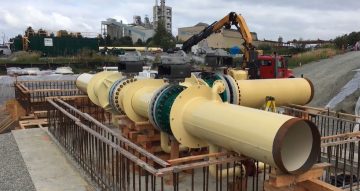
In 2020, Dr. Banthia and his team partnered with Metro Vancouver to develop a sewer pipe coating technology aimed at combatting bio-corrosion caused by sulphuric acid produced by bacteria. Implemented at the Tilbury Wastewater Junction Chamber near Annacis Island in Vancouver, this coating technology applies a carbon-neutral, geopolymer coating with biocides to help sewers resist bacterial attack and extend the infrastructure’s service life.
With citations approaching 17,000, Dr. Banthia is known for transferring his knowledge through collaborations and applications on a global scale. He has published over 475 refereed papers and edited 20 volumes. He holds 9 patents and serves on the Editorial Boards of nine international journals.
“I am extremely honoured to be receiving the Jacob Biely Prize. UBC’s Top Research Prize also truly belongs to the exceptional graduate students that I have been fortunate to work with,” said Dr. Banthia.
Dr. Banthia is a fellow of the American Concrete Institute, Canadian Society for Civil Engineering, Indian Concrete Institute, Canadian Academy of Engineering (CAE), Indian National Academy of Engineering (INAE), and the Royal Society of Canada.
On Friday, March 4, UBC Civil Engineering students and faculty gathered for the Department Heat of the Three Minute Thesis (3MT) competition, which showcased research being conducted by PhD students in our department.
3MT is an academic competition that cultivates students’ effective presentation and research communication skills. Participants have just three minutes to demonstrate the significance of their research, in language fit for a non-specialist audience.
The winner of this year’s Department Heat was Sifat Kalam, a PhD student in Dr. Jongho Lee’s CLEAN Lab research group. Preetish Kakoty and Hiroki Fukuda came in second and third place, respectively.
Assistant professors Drs. Zhengbo Zou and Rachel Scholes served as faculty judges who evaluated the presentations.
Read on below to learn more about each participant’s research:
Industrial Wastewater Reclamation Utilizing an Engineered Membrane with Disparate Wetting Ability
Sifat Kalam Supervisor: Dr. Jongho Lee
With the increasing global population and industrialization, it is estimated that by the year 2025, two-thirds of the world population will be under “stress” conditions. While approximately 20% of the global water demand is by different industries, they also impart a huge amount of wastewater load on the environment. These wastewater needs to be treated before discharging due to the presence of high salt and contaminants such as oil, or surfactants.
A membrane-based distillation technology (MD) has emerged as a promising technique for treating these highly-saline industrial wastewater. In this process, water vapor transports across a non-wetting microporous membrane from the mildly high temperature wastewater side to the cold clean water side rejecting salts and contaminants. However, commercially available membranes are prone to fouling by oil that blocks the membrane pores declining the quantity of water recovery.
In addition, surfactants wet the membrane pores that allows salt/contaminant to pass, thus compromising the quality. Therefore, in my PhD research, I have engineered a membrane with disparate wettability: water-loving top layer that will prevent fouling and a liquid repelling bottom layer that will act as anti-wetting. By utilizing this engineered membrane in the membrane distillation (MD) process we can ensure long-term operation with high quality and quantity of water.
Understanding Seismic Risk of Older Buildings in Vancouver for the “Big One” and Impacts on Community Resilience
Preetish Kakoty Supervisor: Dr. Carlos Molina Hutt
Southwest British Columbia has the potential to experience large-magnitude earthquakes generated by the Cascadia Subduction Zone (CSZ). Although tall buildings are not the only structures at risk, they are of special concern due to their susceptibility to long-period ground motions, which are characteristic of large magnitude subduction earthquakes.
Tall buildings in Metro Vancouver, which include a large number of seismically vulnerable pre-1980 reinforced concrete (RC) shear wall buildings, are particularly vulnerable to these earthquakes because the region lies above the Georgia sedimentary basin, which can further amplify the intensity of ground motions at long periods and the resulting damage in tall structures. Earthquake design provisions in Canada do not explicitly consider basin amplification and the consequences of accounting for these effects are uncertain.
To address this issue, my research proposes methods to quantify basin amplification on ground motion shaking during large-magnitude CSZ earthquakes and assesses the impacts of these ground motions on the performance of existing tall RC shear wall buildings. It further quantifies housing recovery, as an indicator of community resilience, to understand the community impacts of the expected seismic performance of these buildings and proposes a tool to evaluate interventions to enhance overall community resilience.
Harvesting Valuable Chemicals from Organic Wastes with Selective Membrane
Hiroki Fukuda Supervisor: Dr. Jongho Lee
Organic wastes from home and industry have been increasing around the world. For reducing the load on the disposal sites and environmental impacts, the wastes are usually treated by microbes. The microbes eat and digest the wastes and then produce some valuable chemicals for us.
Among the bio-produced chemicals, “medium-chain fatty acids” (MCFAs) are getting attention because they can be used as biofuels and feedstocks for medications and cosmetics. However, it is challenging to separate and purify MCFAs from the mixture of organic compounds produced by microbes. To address the problem, this study succeeded in making a membrane, called “supported liquid membrane” (SLM), that can separate MCFAs selectively. The membrane was able to separate more than 95% of MCFAs from the mixture.
The study is working on the improvement of the membrane performance by studying how fast MCFAs can pass through the membrane and how long the membrane can last. Overall, we highlight the potential of the selective membrane in building a new production stream for valuable chemicals from organic wastes.
Nemy Banthia, a professor of civil engineering at the University of British Columbia (UBC), and his doctoral student Mohammed Farooq have developed a sensor network that can detect the early stages of mudslides and bridge foundation failures that are caused by flooding.
What happens when rushing water assaults a bridge is not an academic question, as British Columbians found out recently.
Torrential rain in November 2021 and the resulting floods damaged many bridges and caused one, at Merritt in B.C.’s interior to collapse.
“Flooding causes foundation loss due to persistent, large-volume and high-velocity flows of water that bridge foundations are not designed for,” said Banthia. “Once the foundation has been lost, collapse of the bridge is inevitable.”
This is how the UBC-developed system works.
An array of dielectric sensor, also called capacitance sensors, are placed at the foundation of bridges where the impact of flooding is most severe.
The sensors monitor the underwater condition of the foundations by detecting changes in their electromagnetic properties.
They also provide early indication of any erosion of stable, compacted soil around the foundations and the build-up of any loose, unstable soil that has been caused by flooding.
The data captured by the sensors is transmitted wirelessly by low-power, low-cost microcontrollers to the cloud for analysis and visualization.
After 22 years of service to the Civil Engineering Department at UBC, professor Susan Nesbit retired in January this year.
During her time in the Department, Professor Nesbit’s knowledge and passion for sustainability in engineering practice strongly influenced the way the Department’s Civil Engineering program is conceptualized and delivered. She became known across UBC’s campus and beyond as someone with significant experience in translating sustainability research into course curricula.
Starting in the early 2000’s, while sustainability in engineering was viewed as a fringe subject, Dr. Nesbit developed and taught numerous sustainability-focused courses, at all levels and including several core courses in UBC Civil Engineering’s undergraduate program. Most recently, she was instrumental in establishing UBC’s new four-year undergraduate Environmental Engineering degree (ENVL), which launched in fall 2020.
Dr. Nesbit selected as one of six inaugural UBC Sustainability Fellows in 2010
Throughout her career, Prof. Nesbit has studied sustainable development and strived to align her teaching practice with research results from studies of university-level education for sustainability. She has been active in the international Engineering Education for Sustainable Development community, co-chairing their biannual conference in 2015, which took place at UBC. She has also been among a small number of UBC Applied Science professors who have published papers in peer-reviewed engineering education journals.
“Looking back at my career makes me feel grateful for my colleagues and friends from across the UBC campus and especially from within the Civil Engineering Department. How fortunate am I to have worked in an arena where all of us value education and, on a personal basis, all of us strive to continually learn and improve,” she says.
Prof. Nesbit graduated from UBC with a degree in Post-Confederation Canadian History in 1981. After time spent working as a salmon gillnet fisher, she decided to return to school to earn a degree in Chemical Engineering. She then worked in the pulp and paper sector for two years, before returning to school to obtain her doctoral degree in Chemical Engineering.
Always interested in environmentalism, it was during her doctoral studies that she became involved with the Sustainability Committee of the Association of Professional Engineers and Geoscientists of BC (now EGBC), which ignited her passion for sustainability education. In 2000, she became the Civil Engineering Department’s first tenure-track instructor.
Dr. Nesbit with students in 2019
Since then, Dr. Nesbit’s wholistic approach to sustainability education has influenced sustainability teaching at UBC, particularly within Civil Engineering programs.
From 2006 to 2012, an integral component of Dr. Nesbit’s teaching practice was community-based learning (CBEL), which introduced sustainable complexity to engineering students. Over 130 projects were completed by her students, who partnered with community organizations located in Vancouver’s downtown eastside and elsewhere in the Greater Vancouver region. During this period, she was also one of UBC’s inaugural sustainability teaching fellows and, as such, co-developed UBC’s Graduating Student Sustainability Attributes. She subsequently advised the UBC Sustainability Initiative’s teaching and learning office through to 2015 as its senior sustainability teaching fellow.
Dr. Nesbit was also instrumental in the development of the Civil Engineering Department’s program-level learning outcomes and wrote the department’s first Graduate Attributes report which contributed to the successful professional accreditation of our program in 2014.
Student testimonials consistently commend Prof. Nesbit for her insightful, interactive, and applicable ways of teaching sustainability. Peers are inspired by her approach to both delivering course material and motivating students to think critically about their role as future engineers in an ever-changing world.
Over her career, Prof. Nesbit taught thousands of students, mentoring many, participated in numerous student-organized conferences as a discussion panelist or invited speaker, and gave guest lecturers to students both in and outside of UBC. In 2017 and 2018 she co-developed and facilitated week-long sustainability workshops for graduate students studying the built environment, from European, Canadian, and American universities.
“I feel privileged to have been part of the lives of so many students, if only for a brief time. I find student enthusiasm, their capabilities, and tremendous potential, to be wondrous and, well, inspiring,” she says.
Now retired, Dr. Nesbit is cultivating a healthier lifestyle that includes more quality time with family and friends. She is also forging ahead with new ventures. Among them, partnering with her husband on an ecosystem stewardship project, “So much to learn about how nature works and very satisfying to finally walk the talk! Great fun!” she says.
Donna Seto, who works in our Department as Manager of Research and Strategic Initiatives, was recently featured on CBC News for her art, which are creating a splash on social media.
Seto’s illustrations are based on archival photos to show what the buildings looked like when its businesses were flourishing.
The paintings have received hundreds of likes on Twitter, and Seto says her work has sparked conversations with people who have fond memories of the neighbourhood.
The Vancouver-based artist says the project is a way to shed a positive light on Chinatown and to create dialogue around ways to revitalize the area, which has seen increasing crime and vandalism.
111 E Pender in #chinatownYVR would have been my kind of place. Built in 1903 for an anti-discrimination hero, Chu Lai, this building was once home to the ‘Green Door’ which was a ‘secret’ location for poets, academics, & revolutionaries during the ‘60s & ‘70s. #Vancouverpic.twitter.com/QCcgxK7nVG
“It’s an opportunity for us to kind of really rethink what it actually looks like and how we can actually preserve these buildings,” she said.
Fred Mah, president of the Chinatown Society Heritage Buildings Association, says he has seen a few of Seto’s pieces, which remind him of when the neighbourhood was thriving.
From the 1950s to 1970s, he says, the streets were packed with people visiting the shops, restaurants and nightclubs in the area.
“We really, really enjoyed going down there,” he said.
Seto has painted some of the 12 historic buildings looked after by the Chinatown Society Heritage Buildings Association, including the Cheng Wing Yeong Tong Society Building and the Chin Wing Chun Society Building.
Donna Seto’s portfolio includes research development, EDI&I initiatives, and strategic planning. She works in partnership with SPARC and APSC Research & Partnerships team, and advises the development of strategic communications in the Department of Civil Engineering.
Data tracking concentrations of COVID-19 in wastewater from sewage plants around Lower Mainland confirm that the Omicron surge is declining.
Wastewater samples at four of the sewage plants, including the Lions Gate sewage treatment plant on the North Shore, show virus concentrations peaked on Jan. 5. (One in Langley showed a peak on Jan. 17.)
Since then, COVID-19 concentrations have been gradually decreasing across the Lower Mainland.
While concentrations of the virus markers remain high compared to earlier waves of the pandemic, “it’s certainly on the downward trend,” said Natalie Prystajecky, a microbiologist who heads the wastewater testing program at B.C.’s Centre for Disease Control. “And each week, the load of virus is decreasing.”
That’s good news, because with only a small fraction of suspected COVID-19 cases being tested and reported in official case numbers, “It’s one of the only signals we have that’s what happening in the community,” saidRyan Ziels, an assistant professor in the University of British Columbia’s department of civil engineering, who has also been among the researchers studying the wastewater trends.
“I do think it’s one of the better indicators right now. We can essentially test one and a half million people in a big pooled sample.”
However, within the Department of Civil Engineering, you should expect all CIVL courses, including labs and capstone projects, to be delivered online until February 7th.
At this time, you should make plans to be in Vancouver in advance of this date so that you can return to campus on February 7th.
As always, our Student Services team is available to provide guidance and support as you move through the term.
If you have any further questions, please contact Kali at undergradsupport@civil.ubc.ca for undergraduate program matters, and Kevin at gradsupport@civil.ubc.ca for graduate program matters. They will be happy to assist you or direct you to appropriate contacts and resources on campus.
Two years ago, on January 8, 2020, Ukraine International Airlines Flight PS752 was shot down shortly after taking off from the Tehran Imam Khomeini International Airport, killing all 176 people onboard, including 63 Canadians. Among those were four members of the University of British Columbia community, including Dr. MehranAbtahi, who was a postdoctoral research fellow in our Department.
Born and raised in Iran, Dr. Abtahi came to UBC in 2019 after completing his PhD in Process and Environmental Engineering at the Université de Toulouse, University of Twente, and Katholieke Universiteit Leuven. His doctoral research focused on the removal of micropollutants from wastewater using bioaugmented-moving bed biofilm reactors, nanofiltration membranes, and annealed polyelectrolyte multilayer-based membranes.
While in Iran, he obtained a Master of Science in Civil and Environmental Engineering from the University of Tehran and a Bachelor of Science in Agricultural Engineering from Azad University. He also worked as a Senior Expert with Parsjooyab Consulting designing modern water and wastewater treatment plants.
Dr. Abtahi published numerous refereed papers and served on the editorial board of the Journal of Environmental Health and Sustainable Development.
In the short time that he worked in the Department, Dr. Abtahi made a strong impression as someone who was diligent, selfless and always willing to support others.
In honour of the memories of him and the other UBC members whose lives were lost in the tragedy, the UBC and the Iranian-Canadian community established the Iranian Student Memorial Award, which is annually awarded to “outstanding undergraduate and graduate students of Persian or Iranian heritage, or who are studying Persian Studies.”
On the second anniversary of this tragic event, we are thinking of the families, friends, and colleagues of not only Dr. Abtahi, but of all the individuals who were lost to the disaster.
5G Internet technology is powering a new generation of smart technologies collectively known as the ‘Internet of Things.’ After the worst flooding in B.C.’s modern history, could the new tech also save our homes and bridges?
The next generation of wireless internet technology has led to some big promises — more bandwidth and faster response times are expected to be crucial to technologies such as autonomous vehicles and remote medicine.
Often overlooked in popular imagination is the so-called “Internet of Things,” technology that allows for the deployment of a vast array of low-powered digital sensors that live-stream large datasets to a cloud.
Such low-cost sensors have allowed people to monitor everything from the ideal fermenting temperature at a brewery in Port Moody to how much electricity British Columbians use at home.
After the worst flooding event in B.C.’s modern history, could it also save lives?
According to University of British Columbia researcher and engineer Nemy Banthia, that answer is a resounding ‘yes.’
Together with his doctoral student Mohammed Farooq, Banthia has developed a real-time monitoring system that detects flood-triggered mudslides and bridge failures before it’s too late.
Professor Dharma Wijewickreme has been awarded the prestigious 2022 John B. Stirling Medal by the Engineering Institute of Canada (EIC) for his leadership and distinguished service at the national level within the Institute and/or its Member Societies, by members of these Societies.
An internationally-recognized expert in earthquake and pipeline engineering, Dr. Wijewickreme first joined UBC in 2001 and has since dedicated his research and teaching to the earthquake response of soils and using advanced laboratory geomaterial characterization to solve geotechnical engineering problems.
Dr. Wijewickreme has authored over 150 journal articles and conference proceedings, and is an Elected Fellow of the Canadian Society of Civil Engineering and the Canadian Academy Engineering. He was the President of the Canadian Geotechnical Society (CGS) for the two-year term (2017-2018), and he served as the Vice President Finance of the CGS between 2013 and 2017.
“It is a great honour for me to receive this distinguished award. I am grateful to the Canadian Geotechnical Society, a world-renowned volunteer-based learned society, that gave me tremendous opportunities to contribute to the geotechnical profession at many levels by providing a platform to work with amazing teams of young and highly experienced geo-professionals,” said Dr. Wijewickreme.
The B.C. government declared a provincial state of emergency to support recovery efforts from the widespread damage caused by severe flooding and landslides.
Several faculty members from UBC Civil Engineering spoke to media to offer their analysis and expertise on the challenges ahead with infrastructure rebuilding:
Coquihalla Highway reopens today ahead of schedule – CBC’s The Current with Matt Galloway (Audio), December 20 Dr. Amy Kim talks about making highways like the Coquihalla more resilient to climate change.
When surging floods meet expanding pipelines – The Tyee, November 23 Dr. Dharma Wijewickreme gave comments about using pipelines to transport fluid over long distances, and the risks that floods pose to pipeline infrastructure
Professor Michael Isaacson and Director of Safety & Research Facilities Scott Jackson have been honoured by the Faculty of Applied Science with the Dean’s Award for Excellence in Service.
Recognizing faculty and staff who through leadership, service, and administrative activities make substantial and high-impact contributions to their Departments and the Faculty, the awards were given out by APSC Dean James Olson at the Festive Celebration on December 8.
“Michael and Scott have both made exceptional contributions to the Department as leaders and community members,” said Department Head Bernard Laval. “I am privileged to work alongside them and on behalf of the entire department, I congratulate them on this well-deserved recognition.”
Dr. Michael Isaacson is honoured for his extensive service contributions to the Department over many years. As the previous Associate Head for academic programs, he assessed and revamped most of the Department’s policies and procedures in both the graduate and undergraduate programs. He has also led efforts to revamp reporting for CEAB under the new graduate attributes system.
Dr. Isaacson’s legacy will include a robust system for measuring and reporting attributes that will serve the Department for years to come.
Scott Jackson is recognized for his career-long service to the Department, which includes tirelessly working to build a strong culture of health and safety. He is particularly noted for his efforts over the past two years, during when he was instrumental in keeping students, staff, and faculty safe during the global pandemic, as well as spearheading a safe and efficient return to campus.
Having joined UBC Civil Engineering in 1986, Scott Jackson is one of the bed rocks that the Department is built upon and has made this place a safer place of study and work for all.
This past Wednesday, December 15, faculty members from our Department: Drs. Jonathan Fannin, Amy Kim, Steven Weijs, Dharma Wijewickreme, and Scott McDougall from UBC Geological Engineering joined host APSC Dean James Olson and moderator Nemy Banthia to share their observations on the November B.C. floods and landslides.
A panel of engineers says better forecasting and co-ordination could help prepare British Columbia for natural disasters, while they warn the spring thaw and rain may compound damage caused by recent floods.
The experts from the University of British Columbia shared their preliminary observations Wednesday on November’s floods, with geotechnical engineer Jonathan Fannin warning that snowmelt in the spring could add new pressure to dikes, highways and bridges.
“I think it’s in the back of our minds as the next expected demand on our system,” he said.
Spring thaws were responsible for the most catastrophic flood events in the Fraser Valley before the flooding this fall, Fannin said. They more commonly affect the Fraser River, not the Sumas River, which spilled onto farmland in Abbotsford, B.C.
In Merritt, a town of 7,000 that was ordered to evacuate last month, spring thaws are responsible for about 70 per cent of flood events, though they tend to be less severe than fall flooding, said Steven Weijs, an expert on hydrological modelling.
“Now we’re, of course, in a special situation because we have damaged infrastructure, which is more vulnerable,” he said.
In order for us to continue to improve the Equity, Diversity, and Inclusion (EDI) in our programs and services we invite your feedback regarding your EDI experiences within the Faculty and recommendations on the following topics:
Curriculum
Programs
Extra and co-curricular activities
Mistreatment or inappropriate conduct that you have experienced or witnessed
Ongoing concerns or challenges
Workplace culture
Physical environment
All feedback and recommendations submitted are anonymous, and the system is intended for general information only. We cannot accept or respond to claims about individual students, staff, or faculty members, and this system cannot be used to resolve specific concerns or situations.
Four-year bachelor degree in Civil Engineering* (domestic or international)
English proficiency
One (1) letter of reference
Resume/CV
Undergraduate Degrees Applicants with a degree that is not in Civil Engineering should be aware that, at the time that a recommendation for admission is made, the Specialty Advisor will be requested to provide a justification regarding the suitability of the applicant for pursuing a graduate degree in civil engineering. However, students should not communicate with the relevant Specialty Advisor regarding this justification, unless invited to do so.
English Proficiency If your degrees is not from Australia, Botswana, Canada, Ghana, Ireland, Kenya, New Zealand, Nigeria, South Africa, UK, USA, Zaire, Zimbabwe or the English-speaking countries of the West Indies, you are required to submit an official English language test score, typically TOEFL or IELTS.
Below you will find the minimum test scores to be considered for admission into any of the graduate programs at the Department of Civil Engineering at UBC:
TOEFL iBT:
Total
Reading
Listening
Speaking
Writing
100
22
22
21
25
IELTS:
Total
Reading
Listening
Speaking
Writing
7.0
6.5
6.5
6.5
6.5
Letter of Reference The application system will require you to complete all three fields of referee email addresses. Please enter your actual referee’s email address in the first field, and populate the second and third fields with a placeholder email address. Use your own email address in these fields. If the system asks you for further detail about the second and third referees, write N/A in all fields.
Please note:
The Department will not accept letters from granting institutions stating that the medium of instruction is English.
If your transcripts states that the medium of instruction was English then you do not need to provide the results of an English proficiency exam.
Score reports more than two years old will not be accepted.
We only require you to submit official hard copies of transcripts and or your IELTS if you have been recommended for admission to the program. If you are recommended you will receive an email from the department requesting your official documents. All the details you need, mailing address etc. will be contained in the email.
We cannot accept IELTS/TOEFL scores after the application deadline. Once that deadline date has passed you will not be able to upload any documents.
Prior Degrees Applicants with an undergraduate and/or Masters degree that is not in Civil Engineering should be aware that, at the time that a recommendation for admission is made, the Specialty Advisor will be requested to provide a justification regarding the suitability of the applicant for pursuing a graduate degree in civil engineering. However, students should not communicate with the relevant Specialty Advisor regarding this justification, unless invited to do so.
English Proficiency If your degrees is not from Australia, Botswana, Canada, Ghana, Ireland, Kenya, New Zealand, Nigeria, South Africa, UK, USA, Zaire, Zimbabwe or the English-speaking countries of the West Indies, you are required to submit an official English language test score, typically TOEFL or IELTS.
Below you will find the minimum test scores to be considered for admission into any of the graduate programs at the Department of Civil Engineering at UBC:
TOEFL iBT:
Total
Reading
Listening
Speaking
Writing
100
22
22
21
25
IELTS:
Total
Reading
Listening
Speaking
Writing
7.0
6.5
6.5
6.5
6.5
Please note:
The Department will not accept letters from granting institutions stating that the medium of instruction is English.
If your transcripts states that the medium of instruction was English then you do not need to provide the results of an English proficiency exam.
Score reports more than two years old will not be accepted.
We only require you to submit official hard copies of transcripts and or your IELTS if you have been recommended for admission to the program. If you are recommended you will receive an email from the department requesting your official documents. All the details you need, mailing address etc. will be contained in the email.
We cannot accept IELTS/TOEFL scores after the application deadline. Once that deadline date has passed you will not be able to upload any documents.
There is no established minimum score for admission; test scores simply provide the admissions committee with additional information about your academic abilities
Resume/CV
Prior Degrees Applicants with an undergraduate and/or Masters degree that is not in Civil Engineering should be aware that, at the time that a recommendation for admission is made, the Specialty Advisor will be requested to provide a justification regarding the suitability of the applicant for pursuing a graduate degree in civil engineering. However, students should not communicate with the relevant Specialty Advisor regarding this justification, unless invited to do so.
English Proficiency If your degrees is not from Australia, Botswana, Canada, Ghana, Ireland, Kenya, New Zealand, Nigeria, South Africa, UK, USA, Zaire, Zimbabwe or the English-speaking countries of the West Indies, you are required to submit an official English language test score, typically TOEFL or IELTS.
Below you will find the minimum test scores to be considered for admission into any of the graduate programs at the Department of Civil Engineering at UBC:
TOEFL iBT:
Total
Reading
Listening
Speaking
Writing
100
22
22
21
25
IELTS:
Total
Reading
Listening
Speaking
Writing
7.0
6.5
6.5
6.5
6.5
Please note:
The Department will not accept letters from granting institutions stating that the medium of instruction is English.
If your transcripts states that the medium of instruction was English then you do not need to provide the results of an English proficiency exam.
Score reports more than two years old will not be accepted.
We only require you to submit official hard copies of transcripts and or your IELTS if you have been recommended for admission to the program. If you are recommended you will receive an email from the department requesting your official documents. All the details you need, mailing address etc. will be contained in the email.
We cannot accept IELTS/TOEFL scores after the application deadline. Once that deadline date has passed you will not be able to upload any documents.
Congratulations to Jérémie Bonneau, Anurag Krishna, Amir Hassanpour, and Sina Tavasoli on being recipients of the UBC Four Year Doctoral Fellowship (4YF)
The 4YF program provides UBC’s best research graduate students with financial support, which allows the university to attract and support outstanding students from around the world.
Read on below to learn more about their research:
Jérémie Bonneau 4YF Recipient Ice-Ocean Interactions in the Canadian High Arctic Supervisor: Dr. Bernard Laval
An often-overlooked aspect of sea level rise is melting that occurs below the ocean’s surface; rising ocean temperatures are responsible for a significant portion of sea level rise. Water properties and currents of the Arctic and Southern Oceans greatly influence tidewater glaciers and ice shelves. Conversely, tidewater glaciers and ice shelves can have a deep impact on the regional circulation and water properties. Jérémie studies the interactions between these ice structures and the ocean.
Jérémie’s research focuses on fjords and ice shelves of the Canadian High Arctic, which are relatively unstudied compared to their Antarctic and Greenlandic cousins. To measure the ocean, he uses moorings and vertical profilers that measure temperature, salinity, pressure and currents. These measurements are used to get a partial portrait of the hydrography around tidewater glaciers and ice shelves. He then combines these observations with numerical models to get a full portrait and quantify heat, salt and freshwater fluxes around these ice structures.
Anurag Krishna 4YF Recipient Data Driven Carbon Negative Approach for Automated Robotic Construction to Address Canada’s Housing Supply Challenge and Carbon Neutrality Response Supervisor: Dr. Nemy Banthia
The Canadian building sector is due for an upgrade. It’s currently overly reliant on carbon, with virtually non-existent use of advanced technologies such as robotics and data analytics. It faces a rapid loss of serviceability. Anurag’s research explores the use of innovative materials and processes that accelerate construction, are more durable against environmental stressors, save cost long-term, and will help meet Canada’s 2050 “Carbon-neutral” promise.
In his research, Anurag explores using 3D concrete printing (3DCP) technology for Canadian climates, which will provide better control and precision, eliminate waste, reduce labor hours, minimize workplace injuries, and expedite construction. Moreover, as the materials will be tested for their printability at nearly 0 degrees Celsius, it will help extend the construction season in the Canadian North. Using data analytics, multiple elements such as time, extrusion rate, printing speed, materials, and space can be handled simultaneously through the use of data-controlled printing algorithms. This will significantly increase the efficiency of the printing system. Using the processes developed, a single-story family demonstration house will be built near Squamish First Nation in Vancouver. The developed technology will be applicable to all geographical regions of Canada.
Amir Hassanpour 4YF Recipient Human-electric Hybrid Vehicles: Implications of New Non-auto Mobility Options for Street Design and Policy Supervisor: Dr. Alex Bigazzi
New mobility options such as electric bicycles, e-scooters and e-skateboards create opportunities to address enduring challenges in the transportation sector, such as traffic congestion, air pollution, climate change, public health, energy consumption, and more. At the same time, they present new challenges to urban transport systems where there is already competition for space and access among road users, which can spill over into conflicts. How can we capture the potential benefits of these new travel options, while mitigating the risks of a wider variety of vehicles and services operating within constrained city street spaces?
Amir’s research will address two broad questions: 1) How will new non-auto mobility options (electric bicycles and other no-/low-power vehicles) impact speed dynamics on non-auto facilities and interactions among non-auto travelers? and 2) Given these new non-auto mobility options, what transportation system policies, plans, and designs are needed to mitigate conflicts among non-auto modes?
Sina Tavasoli 4YF Recipient Rapid Post-Earthquake Regional Seismic Damage Assessment Supervisor: Dr. Tony Yang
Traditional post-earthquake regional damage assessments rely mostly on human inspection, which is often time-consuming and susceptible to human error—the accuracy of these assessments varies significantly depending on the skill set of the inspector. A typical assessment of a building can takes days. And for assessments of entire regions, up to months. This leads to the loss of precious lives and assets.
Therefore, rapid post-earthquake damage assessment is critical in the early moments after the occurrence of an earthquake in order to provide insight to decision makers for efficient allocation of resources and better dispatching of forces. Sina’s research aims at employing vision-based techniques for real-time automatic scanning of structures to detect and assess all damages in buildings and identifying the post-earthquake structural state. It also aims to provide a more accurate estimate of the expected loss of each building and the possible rate of casualties.
Professor Alex Bigazzi has partnered with the District of Saanich to launch the first local rebate program in BC for residents purchasing new electrically assisted bicycles (e-bikes).
By assisting residents who wish to switch to electric mobility, this rebate program aims to reduce local greenhouse gas (GHG) emissions and increase awareness of the economic and health benefits of e-bikes. Estimated to save between 1,000-2,000 tonnes of GHG emissions, the pilot program aims to cut community emissions by half by 2030.
Providing up to $1,600 in rebates, the program is designed to be equitable and accessible to everyone regardless of income level.
Dr. Bigazzi and his team of researchers at the UBC REACT Lab will take on the crucial role of assessing the impacts of the pilot program on travel behaviour and GHG emissions.
“To successfully incorporate e-bikes (and e-bike promotion) in our climate action plans, robust evidence on the real-world, long-term impacts of e-bike adoption on greenhouse gas emissions is crucial. So we are very excited to be able to partner with Saanich on this initiative, and conduct a rigorous scientific study of program impacts,” said Dr. Bigazzi.
To learn more about the program, including pre-register instructions and a list of participating bike stores, check out the full story.
Professor Dharma Wijewickreme has been recognized with the 2021 G. Geoffrey Meyerhof Award by the Canadian Geotechnical Society (CGS) for his “outstanding contributions to soil mechanics and foundation engineering.”
Dr. Wijewickreme has built a distinguished research track record in earthquake and pipeline engineering since joining UBC in 2001. He is internationally known for his research work on the earthquake response of silty soils and performance of buried pipelines subject to ground movement hazards.
During his previous 11-year tenure in industry practice as a geotechnical engineer, he contributed extensively to the seismic design and retrofit of several major highway bridges, pipeline systems, and large industrial plants.
In 2015, Dr. Wijewickreme established the UBC Pipeline Integrity Institute (PII), with the vision to champion world-leading pipeline innovation and practices through advanced education, training, and applied research.
“I am honoured and humbled to receive this award; being able to work with, mentor, and train brilliant graduate students and see them become highly qualified professionals and contribute to Canada and the world, is massively rewarding,” said Dr. Wijewickreme.
Dr. Wijewickreme’s current research focuses on systematically understanding the complex effects of particulate structure on how soils behave during earthquakes.
Dr. Wijewickreme served as the President of the Canadian Geotechnical Society for the two year period 2017-2018. He is a Fellow of the Canadian Academy of Engineering, Canadian Society for Civil Engineering, and Engineering Institute of Canada. In 2013, Dr. Wijewickreme became the recipient of the Canadian Society for Civil Engineering Horst Leipholz Medal for outstanding contributions to Engineering Mechanics and Practice in Canada.
After working virtually on their design over the past year, UBC Civil Engineering student team UBC Seismic placed first in the 2021 Earthquake Engineering Research Institute (EERI) Undergraduate Seismic Design Competition.
The competition, organized by the EERI Student Leadership Council (SLC), annually brings together students from over 50 universities across the globe. The goal is to create a balsa wood structure, which is tested on a shake table that produces up to magnitude 9.0 earthquakes.
For the 2020-2021 school year, UBC Seismic was comprised of 26 undergraduate students, with 22 from Civil Engineering and the rest representing Land and Food Systems, Materials Engineering, Integrated Engineering, and Environmental Engineering.
UBC Seismic’s goal is to promote the study of structural and earthquake engineering through opportunities to work on architecture, construction and design. Participating in the team also provides leadership development opportunities and experience working with industry software such as SAP2000, AutoCAD and Revit.
Due to the COVID-19 global pandemic, the competition shifted to being hosted virtually, which also resulted in a format change that saw participants produce written deliverables. This change especially challenged the team to research new areas in geotechnical, structural, architectural, and retrofitting concepts.
Pre-pandemic, the team would meet in-person every Saturday and build two towers out of balsa wood to prepare for the competition. Instead, all meetings and work over the past year took place virtually.
“Having virtual meetings, new competition rules and objectives with different expectations made the planning and participation difficult,” said Construction Co-Lead Carlson Lau (Civil, ‘21).
Yet, from these challenges the team learned important lessons and valuable workarounds.
“We found that recording the meetings and training sessions were very helpful for onboarding new members,” said Co-Captain Kylie Ip (Civil, ‘22), “and we bonded as a team by having games nights and working on unique tasks different from previous years such as drafting drawings, planning construction schedules and targeting LEED BD+C Healthcare certification.”
“The team is grateful that the organizers put together a virtual competition, and while it had some similar elements to the in-person competition, it felt like an entirely new competition. For an in-person competition, constructability and construction quality can play a big role in how well a tower performs in addition to the design. This year, there was a greater emphasis on the technical aspects and report writing,” said Chupik.
UBC Seismic’s final entry included geotechnical, structural, architectural, and retrofitting deliverables for a scaled model of a Seattle hospital building, as well as completing an oral presentation, a poster, and a video.
The team had limited expenses this year due to everything going virtual and chose not to seek sponsorship. Still, they would like to acknowledge the generous contributions from Fluor and Pomerleau, and their existing network of industry sponsors. The team is especially grateful to Bush, Bohlman & Partners for sharing their insight during virtual Lunch and Learns that were hosted this year.
Ip and Chupik noted that since seismic design is not covered in undergraduate structural courses, participating in the design team and competition is a great way for eager students to learn more about earthquake engineering and get challenged to examine the implications of designing in seismic zones.
The Co-Captains are proud of their hardworking team and attribute a large part of their success to the dedication from the members.
A new member to the team, Eric Diehl (Environmental, ‘23) noted, “deciding to join UBC Seismic has been one of my best decisions in university so far. I got to practice a lot of useful programs like AutoCAD, learn a great deal from some very patient upper years, and get adopted into a tight-knit family whose alumni enjoy coming back to help and visit. Plus, now I get to say that my team are world champions, which doesn’t hurt!”
Looking to the future, Ip and Chupik are excited for the new leadership team and a return to in-person activities and competitions.
“We’re starting the transition to new leadership, and are planning to compete in the 2022 EERI competition in Salt Lake City, Utah! Our objective in the coming months is to begin recruitment and prepare for the new season,” Ip said.
If you are interested in joining or learning more about UBC Seismic, please visit them on the following platforms: Facebook, Instagram, LinkedIn, Website.
Civil Engineering Professor and Dean of Equity, Diversity and Inclusion, Sheryl Staub-French has been inducted as a fellow of the Canadian Academy of Engineering (CAE). She is among fifty-two new Fellows this year.
The CAE is a national institution through which Canada’s most distinguished and experienced engineers provide strategic advice on matters of critical importance to Canada. Fellows are nominated and elected by their peers, based on their achievements and service to the engineering profession.
The new Fellows were inducted today in a virtual ceremony due to complications with the COVID-19 pandemic. An official Induction ceremony is tentatively planned for October 2021.
Dr. Staub-French has demonstrated strong technical originality through multidisciplinary research on sustainable building design, digitalization of building information to optimize performance through Building Information Modelling (BIM), as well as extensive collaborations with industry on smart buildings and cities.
Most notably, her work on BIM adoption has resulted in its incorporation into the Roadmap to Lifecycle Building Information Modeling developed by BuildingSMART Canada, the leading institute for Canadian BIM standards development.
Dr. Staub-French has also made significant contributions to the adoption of collaborative work practices, methods, and tools in BIM coordination. Her research on the subject has been translated into industry best practices in the United States and Canada, while her case studies on BIM implementation in small to medium sized enterprises have been downloaded over 10,000 times.
As the first ever Associate Dean of Equity, Diversity and Inclusion in the Faculty of Applied Science, Dr. Staub-French is a strong leader and advocate in advancing equity and diversity in engineering education and the engineering profession.
Dr. Staub-French’s leadership of the Geering Up Engineering Outreach program has significantly expanded the reach of the program, particularly in helping more kids and youth from underrepresented and underserved communities get access to STEM education.
Currently, Dr. Staub-French is leading initiatives to embed EDI, anti-racism and Indigeneity in the Faculty of Applied Science’s systems, structures and culture. Through her innovative research, dedication to the community, and tireless outreach efforts, she has had a significant impact on the work practices and diversity of the engineering profession.
“It’s a great honour to be recognized by the Canadian Academy of Engineering, and a true privilege to be celebrated for your leadership in and contribution to the engineering profession,” said Department Head Bernard Laval. “My sincerest congratulations to Dr. Staub-French.”
Dr. Staub-French is among three UBC Applied Science faculty members inducted this year. The other Inductees are Walter Mérida of Mechanical Engineering and Warren Poole of Materials Engineering.
The UBC Steel Bridge design team, comprised of 50 UBC Civil Engineering undergraduate and Master’s students, recently won first place at the 2021 Canadian National Steel Bridge Competition.
While the team had consistently placed in the top three in previous years, this was their first time winning the top prize. Supervised by faculty members Drs.Noboru Yonemitsu and Carlos Molina Hutt, the team competed against 11 other teams from Canada, Mexico, and China.
Due to COVID-19, the competition was held virtually for the first time. Rather than following a traditional format, the competition shifted its focus towards showcasing design, analysis, and construction sequence in a report and video format.
Over the past year, UBC Steel Bridge has had to adapt to only meeting virtually. Executives worked hard to deliver an engaging online experience, which included a recurring accessibility survey to ensure a smooth and enjoyable experience for all attendees.
“On the other hand, online meetings allowed members to attend from the comfort of their homes and from all parts of the world. As a result, we had the highest participation this year ever,” said team Co-Captains Cindy Khailor (Civil, ’21) and Davis Su (Civil, ’21).
UBC Steel Bridge’s winning design this year marked the first time in many years they successfully designed a “pony truss” bridge, which is a type of arched truss bridge.
“In the past, we’d always had trouble designing this type of bridge due to increased complexity compared to our typical designs,” said Khailor and Su, “We decided to take a risk this year.”
To make the design feasible, the team explored unique fabrication techniques such as laser cutting, which significantly reduced fabrication times. Previously, long fabrication time was a limiting factor.
“We hope these new techniques will allow us to develop even more complex designs in the future,” said Khailor and Su.
UBC Steel Bridge’s goal is to create a space for students to practice classroom skills such as engineering software, teamwork, and communication through working on real-life projects. The team seeks to cultivate the next generation of engineers by encouraging them to develop innovative solutions to classic structural problems.
“Often times, we learn about equations and analysis in school without realizing all the other factors that might affect a design’s behaviour once it’s built,” said Khailor and Su.
“We want to say a big thank you to our numerous sponsors; it takes a lot to get us to where we are. It’s all of you who contribute, even just a little, that allows us to have continued success and to support our members in learning important engineering skills,” said the captains.
Khailor and Su expressed excitement for the team to work together in-person again (COVID-19 situation permitting), and plan to create an even more engaging experience and a greater sense of community for UBC Steel Bridge members, alumni, and sponsors next year.
“We have a large number of members returning to the team next year, and incoming leads are inspired with plans to improve work efficiency, tutorials, and learning tools,” they said.
Researchers can now eliminate almost all errors produced by a widely used portable DNA sequencer, thanks to a new method developed by UBC Civil Engineering Assistant Professor Dr. Ryan Ziels. This advancement will potentially enable scientists out in the field or in smaller labs to study microorganisms, such as the SARS-CoV-2 virus, much more accurately and efficiently.
According to Dr. Ziels and his research partners at Aalborg University in Denmark, this new method adopts a unique barcoding system that was found to significantly reduce the error rate of Oxford Nanopore Technologies’ MinION device—from as high as 15% to less than 0.005%.
“The MinION has revolutionized the field of genomics by freeing DNA sequencing from the confines of large laboratories,” said Dr. Ziels. “But until now, researchers haven’t been able to rely on the device in many settings because of its fairly high out-of-the-box error rate.”
The method is described in a paper published in the journal Nature Methods.
Adopting a barcoding system that utilizes the tagging of each target DNA molecule in a sample, this method allows researchers to easily identify and group relevant DNA fragments.
The result is near-perfect sequencing of fragments that are up to 10 times longer than what conventional technologies can achieve.
The use of genome sequencing can reveal a great deal about an organism’s identity, ancestry, strengths, and vulnerabilities, enabling potentially groundbreaking diagnostic tools and treatments to be developed.
However, without reliable portable DNA sequencers, crucial details could be missed during field research or in smaller laboratories.
Fortunately, Dr. Ziels and his collaborators have made the code and protocol available through open-source repositories, allowing virtually any lab in the world to benefit from this method.
“A beautiful thing about this method is that it is applicable to any gene of interest that can be amplified,” said Dr. Ziels. “This method can be very useful for fields where the combination of high-accuracy and long-range genomic information is valuable, such as in cancer research, human genetics, plant research, as well as microbiome science.”
Dr. Ziels is currently collaborating with Metro Vancouver to expand upon this method for near real-time detection of microorganisms in water and wastewater.
“By obtaining a more accurate picture of the microorganisms present in water systems, communities may be able to improve their public health strategies and treatment technologies — and better control the spread of harmful microorganisms like SARS-CoV-2,” said Dr. Ziels.
This research was supported by Genome Canada and the Natural Sciences and Engineering Research Council (NSERC).
The Used-Water to Resources (U-WatR) initiative, led by Civil Engineering professor Pierre Bérubé, has been awarded $1.6 million through the Canada Foundation for Innovation’s 2020 Innovation Fund competition.
The competition, which funds up to 40 per cent of a project’s eligible infrastructure costs, aims to “enhance and optimize the capacity of institutions and research communities to conduct the proposed research or technology development program(s),” the Government of Canada announced.
The U-WatR initiative aims to transform existing used water treatment infrastructure into economically and environmentally sustainable assets. One of its main goals is to develop knowledge and technological innovations that will reduce and ultimately eliminate energy use and greenhouse emissions from water treatment.
U-WatR is comprised of a diverse team of emerging and established researchers who are global leaders in their respective fields. Their research outputs have been instrumental to the success of Canadian initiatives such as RES’EAU-WaterNET, and PEOPLE Networks; and global partnerships such as China-Canada Bioenergy Centre, Water Magic, MEMPREX, and MiDAS.
“The infrastructure obtained through the CFI will enable researchers at UBC to develop the novel technologies and solutions needed to transform used-water facilities into resource-generating centres while also protecting human and environmental health,” said Bérubé.
Dr. Bérubé’s initiative is one of nine projects led by UBC researchers that were funded. Together these projects were awarded a total of $28.3 million in research infrastructure support.
For more information, please see announcement by UBC Applied Science.
UBC Civil Engineering Assistant Professor Jongho Lee has received the New Frontiers in Research Fund (NFRF) grant to develop a tri-layer film that mimics natural trees’ water management function – a technology that will help build extreme weather-resilient cities.
A naturally effective dewatering instrument, a tree transpires 97% of the water absorbed by its roots to the atmosphere. This technology aims to mimic this mechanism.
“By attaching the film onto existing buildings, we aim to transform them into a giant forest of artificial trees for fast stormwater removal in excessive rainfall events and effective cooling in extreme hot weathers,” said Dr. Lee.
Although current green infrastructure such as green roofs and rain gardens are effective in stormwater control, retrofitting presents challenges, especially in densely laid out cities where space is scarce.
Attaching this film to existing buildings will not require any additional space.
Dr. Lee and his researchers have been granted $250,000 over two years to work on this project. In this first phase, they will develop the tri-layer film and demonstrate its capabilities on a small scale by installing it on a building on the UBC Vancouver campus.
The idea for this film evolved from Dr. Lee’s previous work on constructing an artificial mangrove tree for desalination.
A collaboration between multiple disciplines, this project is being co-developed with Dr. Feng Jiang from UBC Forestry and Dr. Simcha Srebnik from UBC CHBE, who bring their expertise in plant hydraulics and molecular dynamics, respectively.
Dr. Lee and his collaborators have aligned their project with the Rain City Strategy developed by the City of Vancouver. They hope to bring the City on as a potential collaborator in the future.
To learn more about Dr. Jongho Lee and his research, please visit his Faculty Profile. You may also learn about the perspectives of stormwater control using artificial trees as described in his recent article.
The Department of Civil Engineering adds to our roster of world-class researchers and educators and welcomes Assistant Professor Sara Beck to the Environmental Engineering research group.
Dr. Beck joins the Department after completing post-docs at the University of Colorado and Eawag, the Swiss Federal institute of Aquatic Science and Technology, opportunities that followed a Fulbright at the Asian Institute of Technology in Thailand.
Dr. Beck’s research broadly focuses on understanding and preventing pathogen transmission in water treatment. “The goal is to identify microbial contaminants of concern in drinking water and wastewater sources and to develop and evaluate cost effective and energy-efficient clean water processes to reduce that microbial contamination,” she said.
The development of these technologies may contribute to solving significant problems, as water becomes increasingly scarcer on our resource-limited Earth.
Dr. Beck’s unconventional path took her from a Bachelor’s degree in aerospace and a coveted position at NASA supporting the Space Shuttle program, to cofounding the Central Houston chapter of Engineers Without Borders-USA, to working on small-scale water and power projects in a rural community in Uganda.
“It gave me insight into the challenges faced by many people around the world regarding access to safe drinking water,” she said.
The throughline that connects Dr. Beck’s diverse background is global collaboration from a research perspective, which she is excited to continue to champion at UBC Civil Engineering.
This fall, she will host three researchers from Kenya, the Democratic Republic of the Congo, and Nigeria—all of whom are passionate and driven to improve water quality in their home communities.
“I look forward to giving them a strong foundation and mentoring them, and others, in this next step of their careers,” she said.
“I am delighted to welcome Dr. Beck to our department. Sustainability in a global context is more crucial today than ever, and Dr. Beck brings her passion for the environment and her expertise in clean water, as well as her diverse experiences abroad,” said Department Head Bernard Laval.
Dr. Beck earned her B.S./B.A. in Aerospace Engineering and Studio Art from the University of Colorado Boulder, her M.S. in Environmental Engineering from the Georgia Institute of Technology, and finally her Ph.D. in Environmental Engineering from the University of Colorado Boulder in 2015.
Learn more about Dr. Beck and her research on her Faculty Profile.
Assistant Professor of Teaching Dr. Tamara Etmannski has been recognized with the 2020/2021 Killam Teaching Prize. This award is nominated by students, colleagues, and alumni and recognizes exceptional contributions through teaching.
In addition to serving as a faculty member in the Department of Civil Engineering, Dr. Etmannski holds several academic leadership roles in the Faculty of Applied Science. She is the Academic Director of the Master of Engineering Leadership (MEL) and Master of Health Leadership Policy (MHLP) programs, and Co-Director of the joint UBC/UNBC undergraduate degree in Environmental Engineering.
As Assistant Professor of Teaching, Dr. Etmannski has developed many new courses around sustainability, leadership and entrepreneurship—for both undergraduate and graduate students.
Most recently, she helped co-develop CIVL 403: Engineering Economics Analysis (with fellow Killam Teaching Prize recipient Gabriel Potvin). Sitting at the intersection of politics, sustainability and best practices associated with applying economic principles in technical engineering decisions, this course will add a much-needed interdisciplinary perspective to the existing engineering curriculum. The pilot is set to launch in January 2022, with plans to share modules with other engineering economics instructors in the country through the Canadian Engineering Education Association (CEEA).
“These will be of great interest to the engineering community in Canada, as very little pedagogical material is currently available on the subject,” said Dr. Etmannski.
To bridge the gap between engineering and business and in response to demand from students and industry, Dr. Etmannski spearheaded the creation of the Minor in Entrepreneurship for undergraduate engineers. She collaborated closely with Sauder leadership to allow engineering students to take 300 and 400-level commerce courses without any prerequisites. After a successful pilot, the minor received glowing support from the finance division and launched in 2018.
As Academic Director of the MEL/MHLP programs, she was instrumental in their development, launch, and growth. Currently in their sixth cohort, program outcomes indicate that within six months of graduating, 80% of alumni either get promoted in their current organization, or transition into their chosen sector of specialization. Despite uncertainties surrounding COVID-19, the MEL/MHLP continue to experience record growth year-to-year.
Not one to shy away from experimentation in the name of education, Dr. Etmannski is known among students for her innovative teaching methods. For CIVL 302, she replaced lecture slides with guest speakers, all of whom are practicing engineers with personal stories to share that involve bullying, sexism, and racism in the workplace, as well as other ethics issues such as whistleblowing and conflict-of-interest.
Replacing pre-written case studies with live storytelling has reduced the amount of pre-reading students are required to do before class and allows students to get a more relaxed lecture experience.
“This is being done with the students’ mental health in mind, knowing how much they are struggling with issues related to online learning and COVID in general,” said Dr. Etmannski. “I wanted to bring some humanness and connect to the virtual classroom.”
For her efforts, Dr. Etmannski consistently receives positive feedback from students and achieves high ratings on teaching and course evaluations.
She explains that her teaching philosophy has always been to teach through real-world application. “Engineers appreciate when theoretical concepts are connected to tangible problems, and that’s how I approach my classes—attempting to connect theory with engineering practice as much as possible,” she said.
Dr. Etmannski is one of 24 Killam Teaching Prize recipients from across the campus one of three in Applied Science. Gabriel Potvin (Chemical and Biological Engineering) and Jordi Honey-Rosés (Community and Regional Planning) are also recognized. We congratulate Dr. Etmannski and all other recipients on this prestigious recognition and for their incredible contributions to student learning over the years.